
Self-Respect Habits That Boost Confidence Daily

A person joyfully dancing in a sunlit meadow, surrounded by wildflowers. The carefree movement and bright colors should convey a sense of freedom and self-expression, reinforcing how movement can boost confidence.

Small Acts of Self-Respect That Make a Big Difference

You don’t need a grand gesture to start valuing yourself. It’s the tiny decisions you make every day that quietly shape how you see yourself, and how others see you too. If you’ve ever felt like self-respect is some huge, hard-to-reach ideal, this article is here to shift that perspective.

Self-respect isn’t about perfection. It’s about choosing yourself in moments that matter, even when no one else is watching. This guide explores simple, doable self-respect tips and daily confidence boosters that create lasting internal change without demanding too much of your time or energy.

Why Small Acts of Self-Respect Matter

Respecting yourself is a foundational piece of emotional and mental health. But contrary to popular belief, it doesn’t require a major lifestyle overhaul. The smallest actions, repeated consistently, can reinforce your sense of worth.

The Power of Repetition

Think about how habits form. According to James Clear in Atomic Habits, every small action is a vote for the type of person you want to become. When you act in ways that support your well-being, you’re telling yourself: “I matter.”

What Self-Respect Looks Like

It’s not always obvious. Some of the most powerful acts of self-respect are also the quietest:

  • Saying no to something you don’t want to do
  • Cleaning up your room
  • Dressing in a way that makes you feel proud
  • Noticing when your self-talk turns mean and changing the tone

These aren’t just habits. They’re declarations.

Practical Self-Respect Tips You Can Start Today

 A joyful person engaging in outdoor physical activity, like jogging or yoga in a park. The image should convey energy and vitality, emphasizing how physical fitness contributes to self-confidence.

If you’re ready to build up your self-respect one decision at a time, start here. These strategies are easy to implement and make a meaningful difference fast.

1. Say No Without Overexplaining

You don’t owe anyone an elaborate story about why you can’t commit to something. Your boundaries are reason enough.

Try This:

  • “Thanks for asking, but I can’t.”
  • “That doesn’t work for me.”

Why it works:

  • Conserves your mental energy
  • Builds internal trust
  • Sets a clear example for how others should treat you

2. Clean and Organize Your Space

You might underestimate the emotional weight of clutter until you clear it. A tidy space is a sign that you care about your environment and your mental clarity.

Start Small:

  • One drawer
  • Your desk
  • The corner of your bed

Research-backed: Studies show that cluttered spaces are associated with increased cortisol levels and decreased focus. Tidying up is more than aesthetics; it’s about reducing internal chaos.

3. Dress for Yourself

You don’t need an event to dress well. How you present yourself influences how you feel about yourself.

What to do:

  • Wear clothes that fit and reflect your style
  • Choose colors and fabrics that energize or calm you

Not for others, but for you. Because when you respect how you look, you change how you carry yourself.

4. Speak Kindly to Yourself

Your inner voice sets the tone for your self-respect. If you constantly criticize yourself, how can you expect to feel confident?

Reframe these thoughts:

  • Instead of “I’m so lazy,” say, “I needed rest.”
  • Instead of “I always mess up,” say, “I’m learning and adjusting.”

Mirror Mantras:

  • “I am allowed to take up space.”
  • “I treat myself with kindness.”

5. Nourish Your Body With Intention

Feeding yourself isn’t just survival; it’s an act of self-care. Choosing foods that fuel your body shows that you’re worth the effort.

Sample Self-Respect Meal Plan:

MealWhat to IncludeWhy It Supports Self-Respect
BreakfastProtein + fiber + hydrationFuels energy and focus
LunchBalanced nutrients + colorful vegShows care for your long-term health
SnackMindful treat or fruitValidates pleasure without guilt
DinnerWarm, light, satisfyingHelps you wind down and feel grounded

Self-Respect in Communication and Boundaries

A confident individual standing firm with a backdrop of a blurred crowd, symbolizing the importance of setting boundaries. The person should look assertive yet relaxed, representing self-respect.

The way you engage with others often reflects how you engage with yourself. Setting boundaries doesn’t mean it’s healthy.

Stop Over-Explaining

You don’t have to justify every decision. Practicing this kind of restraint shows that you trust your own judgment.

Try This:

  • “I’m not available.”
  • “That doesn’t align with my current priorities.”

Call Out Disrespect Calmly

When someone crosses a line, addressing it reinforces your value.

Example phrases:

  • “I didn’t appreciate that comment.”
  • “Let’s talk about what just happened.”

It doesn’t have to be aggressive to be powerful. Quiet strength speaks volumes.

Creating a Self-Respect Routine

Just like brushing your teeth, acts of self-respect can become part of your daily flow.

Use a Self-Respect Checklist

Make a visual checklist to remind yourself of what honoring yourself looks like. Here’s a sample:

  • Said no when needed
  • Took five minutes to tidy up
  • Ate a nourishing meal
  • Spoke to myself kindly
  • Wore something I love
  • Set or enforced a boundary

Weekly Self-Check-Ins

You don’t need to journal (unless you want to). You can do a self-check by voice memo, mental scan, or a note app on your phone.

Ask yourself:

  • Where did I show up for myself this week?
  • What felt good to say no to?
  • How did I make space for rest?

Final Thoughts: You Deserve Your Own Respect

You don’t need anyone’s permission to treat yourself with dignity. And it doesn’t take a retreat, a book, or a breakthrough to get started. It begins with choices as simple as making your bed or saying no to a draining plan.

Your self-worth is built in the small moments. These habits add up to a life where you feel stronger, clearer, and more in control.

Make one choice today that says, “I respect myself.”

FAQ: Small Acts of Self-Respect That Make a Big Difference

What are the best self-respect tips for beginners?

Start with habits that feel manageable. Say no once this week. Clean one small area. Compliment yourself out loud.

Can daily confidence boosters really change how I feel?

Yes. Repeated empowering actions alter your perceptions about yourself and how other people treat you.

Is setting boundaries a form of self-respect?

Absolutely. Boundaries guard your time, energy as well as your emotional security all of which is important in terms of self-respect.

How do I stay consistent with self-respect habits?

Build them into your routine. Attach them to things you already do, like getting dressed or eating.


Take action now: Choose one self-respect habit from this article and commit to it for one week. Watch how even small changes shift how you see yourself.

Your self-respect isn’t earned through big wins. It’s built, moment by moment, through the choices only you can make.

Rewire Inner Critic with AI: Build a Kinder Inner Voice

A woman sits on a couch, engaging in a seemingly empathetic conversation with a translucent AI figure. Rewire Inner Critic with AI.

That Voice in Your Head Isn’t Always Right But You Can Change It

That is a familiar-sounding voice. The one that speaks when it is least convenient:

You are too dumb.

You never meet with success.

So, why will other people listen to you?

You know that endless stream of endless chatter in your head that drives you crazy, it may not only cripple your guts and scatter your mind, but it also prevents you from being the person you aspire to become. This voice has been known to be referred to as the inner critic yours and you may be thinking that you are the only one to experience it but you are mistaken. The great news? You have not got it. Using the available tools of artificial intelligence nowadays, you can begin the process of retraining that voice into one that looks out for your health, pushes you towards improvement, and is an accurate representation of the potential that you have.

In this article, I will take you through a step-by-step process on how you can use AI to rewire your inner critic, providing tools, daily activities, and intelligent tactics.

What Is the Inner Critic and Why Does It Hurt So Much?

Understanding the Inner Critic

Your inner critic is a voice that resides in your head which has been stimulated by anything. It can be shaped due to previous life experiences, criticism that is shown by people around you or even the society. It is that internal voice that leaps to conclusions, over-processes and makes assumptions about how you are doing or how valuable you are.

What Causes It?

  • Childhood conditioning and criticism
  • Repeated failures or traumatic experiences
  • Cultural standards of success or perfection
  • Exposure to negative environments

This voice on the inside may appear to want to guide by ensuring you do not make errors or motivate you to achieve greater. However, when it gets cruel and persistent, it transforms into self-deprecation.

Why Rewiring Is Essential

Living under the influence of an unchecked inner critic can lead to:

By changing your inner narrative, you can drastically improve not just how you think, but how you feel and act every single day.

How AI Can Help You Rewire Your Inner Critic

Why AI Works for Mindset Change

AI-based tools today go beyond basic chatbots. They can:

  • Track your emotional language and spot negative patterns
  • Offer constructive, psychologically-backed reframes
  • Encourage self-reflection without judgment
  • Provide real-time support 24/7

AI does not tire, does not humiliate you, does not allow off-days, only listens, thinks, and acts and with the appropriate training, can be your personal development friend.

How It Works (Behind the Scenes)

With the help of NLP (Natural Language Processing), AI can examine how you speak to yourself either in writing or verbally. It then applies cognitive behavioral therapy to provide you with counter thoughts or emotional understanding so that you can dispute the distorted beliefs.

A young woman looks in an ornate mirror; her reflection shows a futuristic AI interface integrated into her mind, suggesting a concept of AI enhancing or modifying cognitive processes.

The Best AI Tools to Transform Your Inner Critic

AI ToolPurposeBest ForFree Plan?
ReplikaConversational AI for supportReal-time self-dialogueYes
JournalGPTGuided daily self-reflection journalingReframing negative thoughtsYes
MindseraAI coaching with CBT-based promptsDeep mindset analysisNo
YouperMental health chatbot for check-insEmotional awareness & balanceYes
Notion AICustom prompt creation & journalingPersonalized affirmation scriptsYes

Each tool has its strengths, but what they all offer is a way to challenge toxic self-talk and train your brain to respond differently.

Create a Daily Self-Talk Rewiring Routine Using AI

Now, the thing is that rewiring your inner critic does not imply shutting it up. It is all about turning that voice into turn into a voice that helps instead of hurting. The following is a basic structure to work with AI:

Morning Mindset Reset

  • Ask your AI: “What do I need to hear today to believe in myself?”
  • Generate 3 customized affirmations
  • Journal one thing you appreciate about yourself

Afternoon Realignment

  • Check in with your AI companion: *”How am I talking to myself today?”
  • Use reflection prompts like:
    • What negative thought came up today?
    • How would a friend respond to that thought?

Evening Reframe & Release

  • Use AI journaling prompts such as:
    • What belief held me back today?
    • What’s one thought I want to carry into tomorrow?

Daily Prompts to Practice With

  1. What am I proud of today?
  2. What did I say to myself that wasn’t kind?
  3. What can I replace that thought with?
  4. What truth is more empowering?
  5. What small win am I celebrating?

Mistakes to Avoid When Using AI for Self-Talk Work

While AI can be powerful, it’s not magic. Here are some things to avoid:

  • Don’t expect overnight results. Your mindset is years in the making.
  • Don’t ignore emotional resistance. Growth is uncomfortable.
  • Avoid tool-hopping. Stick with 1-2 tools consistently.
  • Don’t skip reflection. AI helps, but you still have to show up.

A Real-Life Example: AI Helped Me Rewrite My Story

Say hello to Sarah, a 29-year-old freelance designer. Her inner critic had delivered sabotaging messages throughout years of bad practices against her in client meetings and project launches, such as, “They will find out that you are not actually talented.” Once she downloaded JournalGPT, she began typing every morning and requesting the AI to reflect back on what it had observed. In a matter of weeks, Sarah was able to see some patterns she had never noticed.

She started applying bespoke prompts to revise her thoughts and before long, thoughts about herself changed to, instead, You can make this mistake and learn.

She became full of confidence and got three new clients within a month, having done nothing but change her attitude.

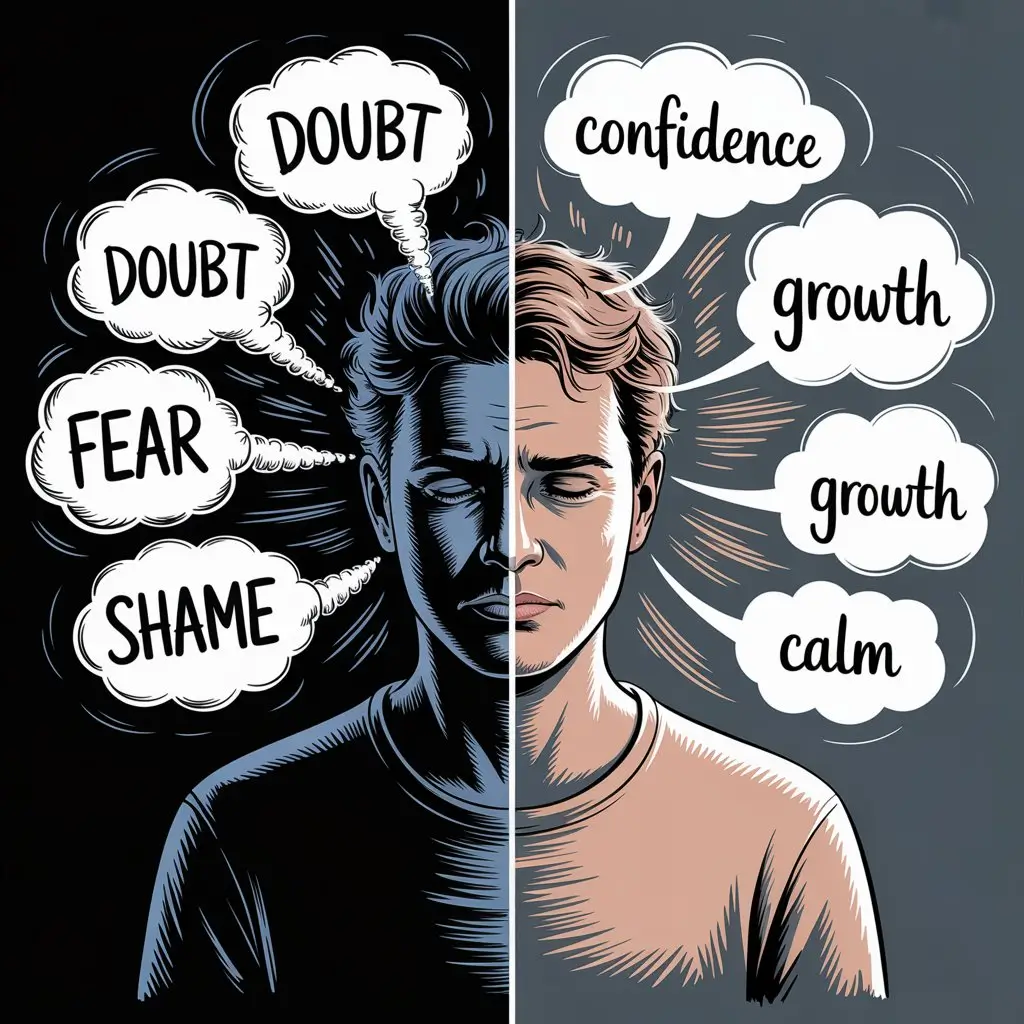
A split image depicts the contrasting mental states of doubt, fear, and shame versus confidence, growth, and calm.

FAQ: Rewire Inner Critic with AI

Can AI really change how I think about myself?

Of course, it depends on how you use it regularly and carefully. AI gadgets are mirrors they are used to show you how you think and slowly move your thinking in another direction.

Is AI therapy?

No. The tools of AI help people do well mentally, and they do not replace a professional therapist. They work better as supplements to rather than replacements of traditional care.

How long until I see results?

With daily practice, 2-4 weeks can see changes in most people, including those combined with affirmations and reflection.

Is it safe to share personal thoughts with AI?

All of the most reliable tools encrypt your information, but read the privacy policy. Do not post information that is highly sensitive and personal.

Conclusion: Start Small, Speak Kindly, and Let AI Help You Grow

You do not always need to live with a mean voice inside your head. You can re-educate your mind, change and renew your beliefs and build a new mindset using smart and caring technology.

Whenever you address your inner critic in a curiosity-based way rather than a judgmental way, you are healing little by little. And, you do not have to do it all by yourself with an AI being your guide.

💬 Ready to Begin?

Pick one AI tool from the list above and commit to using it for the next 7 days. Track how your self-talk changes.

Your mind listens. Make sure it hears something kind.

Empowerment: Transforming Life Through Confidence

A confident woman standing in front of an audience, giving a presentation. Her body language exudes confidence and empowerment, with engaging visuals in the background that highlight her message."

Introduction

Empowerment represents the ability to take control over our own lives, developing the confidence and strength to make meaningful decisions and transform our circumstances. It goes beyond simple momentary motivation; it implies a fundamental change in our perception of what we are capable of achieving and our responsibility in creating our reality.

Historically, the concept has evolved from its roots in social movements to become a fundamental principle of personal growth and psychological well-being. When we empower ourselves, we stop being passive spectators of our lives to become active architects, experiencing benefits such as greater self-esteem, confidence, emotional well-being, more effective decision-making, and more authentic relationships.

Understanding Empowerment: Conceptual Framework

Empowerment encompasses four interconnected dimensions. The cognitive dimension refers to our thoughts, beliefs, and perceptions about ourselves and our capabilities, including self-efficacy and a growth mindset. The emotional dimension involves our ability to recognize, understand, and effectively manage our emotions, developing emotional resilience and emotional intelligence.

The behavioral dimension manifests in our concrete actions and ability to implement effective changes, establishing meaningful goals and persevering despite obstacles. The social dimension recognizes our inherently social nature and includes our ability to establish healthy boundaries, communicate assertively, and build support networks.

The opposite of empowerment is the feeling of powerlessness, characterized by the perception of having little control over our circumstances, with consequences such as depression, anxiety, low self-esteem, passivity, and social isolation.

Psychological Foundations of Empowerment

Several psychological theories underpin the concept of empowerment. Albert Bandura’s Social Cognitive Theory introduces the concept of self-efficacy, our belief in our ability to execute actions necessary to achieve specific results. This belief develops through mastery experiences, vicarious learning, social persuasion, and physiological and emotional states.

Deci and Ryan’s Self-Determination Theory proposes that we have three innate psychological needs: autonomy (feeling that our actions are self-determined), competence (feeling effective in our interactions), and relatedness (feeling connected to others). The satisfaction of these needs fosters intrinsic motivation and psychological well-being.

Research has consistently demonstrated the connection between empowerment and psychological well-being, associating it with greater life satisfaction, more positive emotions, fewer symptoms of depression and anxiety, and better physical health.

Obstacles to Personal Empowerment

Various obstacles can impede our empowerment. Limiting thought patterns include dichotomous thinking, overgeneralization, personalization, and catastrophizing, while excessive self-criticism manifests as relentlessly negative internal dialogue.

Impostor syndrome makes us feel that our achievements are the result of luck or deception, not our abilities. Paralyzing perfectionism establishes impossibly high standards and punishes us when we don’t reach them. Negative external influences, such as toxic relationships or discrimination, can also undermine our sense of agency.

Past traumatic experiences can fundamentally alter our perception of safety and control, while lack of clarity in purposes and objectives leaves us without clear direction, reacting passively to circumstances instead of proactively creating our reality.

A silhouette of a person triumphantly standing on a mountain peak during sunrise, symbolizing empowerment and personal growth. The sky is painted with vibrant oranges and yellows, representing new beginnings.

Inspiring Examples of Empowerment

Malala Yousafzai exemplifies empowerment by defending girls’ right to education in Pakistan under the Taliban regime, surviving an assassination attempt, and transforming this experience into a global platform for change. Oprah Winfrey, born into rural poverty and facing numerous adversities, cultivated a different vision for her life and became one of the world’s most influential communicators.

Dwayne “The Rock” Johnson demonstrates how empowerment allows us to transform setbacks into opportunities, reinventing himself after his dream of playing professional football was frustrated. These stories share common elements: a mindset of possibilities, a clear purpose, persistent action, and the desire to empower others.

The 7 Pillars of Personal Empowerment

The knowledge we have about ourselves combined with our clearly established values help us create an inner guide which directs our decisions. Establishing healthy boundaries allows us to distinguish between what is our responsibility and what is not, protecting our well-being and honoring our needs.

Developing self-confidence and self-esteem determines what we believe possible and what we feel deserving of achieving. Personal responsibility and proactivity involve recognizing that we always have the freedom to choose our response to circumstances, acting based on values instead of reacting impulsively.

Resilience in the face of adversity allows us to recover, adapt, and grow from difficulties. A growth mindset helps us see challenges as opportunities to learn and failure as a natural part of the learning process. Finally, consistent action and perseverance translate our aspirations into concrete behaviors that gradually transform our reality.

Practical Strategies for Living Empowerment

Rewriting our personal narrative involves identifying and questioning the limiting stories we tell ourselves, consciously creating new narratives that reflect our capacity to grow and change. Effective self-affirmation techniques use positive, personal, specific, and present-tense statements to counteract negative thought patterns.

Setting SMART goals (Specific, Measurable, Achievable, Relevant, and Time-bound) provides clarity and structure to our aspirations. Developing assertive communication skills allows us to express our thoughts, feelings, and needs in a clear, direct, and respectful manner.

Creating environments and relationships that foster empowerment, practicing self-care and integral well-being, and cultivating mindfulness and conscious presence are other fundamental strategies for living empowerment in our daily lives.

Empowerment in Different Areas of Life

In personal relationships, empowerment manifests as the ability to form authentic, reciprocal, and nurturing connections, maintaining a healthy balance between autonomy and interdependence. In the professional realm, it is reflected in creating a career aligned with our talents, values, and purpose, taking initiative, and continuously developing our skills.

Financial empowerment involves developing a conscious relationship with money and making financial decisions aligned with our values. In physical and mental health, it means taking an active role in our well-being, educating ourselves, developing healthy habits, and communicating effectively with health professionals.

In the community realm, empowerment allows us to contribute significantly to our communities and participate in creating a more just world, recognizing our interconnection and shared responsibility.

Tools and Resources for Developing Empowerment

Numerous resources can support our empowerment journey. Books like “The Power of Now” by Eckhart Tolle, “Mindset” by Carol Dweck, and “The 7 Habits of Highly Effective People” by Stephen Covey offer valuable perspectives on different aspects of empowerment.

Digital applications for mindfulness (Headspace, Calm), goal setting (Todoist, Trello), habit formation (Habitica), and emotional well-being (Moodfit) provide practical tools for implementing empowerment principles. Coaching programs, mentoring, and support communities offer guidance, accountability, and social connection in our growth process.

Practical exercises such as gratitude, creative visualization, setting daily intentions, conscious self-compassion, values clarification, compassionate self-talk, and mindfulness can be integrated into our daily lives to gradually cultivate a greater sense of empowerment.

Continuous Journey of Empowerment

Empowerment is not a final destination but a continuous journey of discovery and growth. Setbacks and relapses are natural parts of this process, offering opportunities for deeper learning when we approach them with psychological distance, self-compassion, and curiosity.

Celebrating small achievements reinforces empowered behaviors and builds psychological momentum. Maintaining long-term momentum requires anchoring our practices in deep values, designing supportive environments, and adapting our approach as our needs evolve.

The multiplier effect occurs when we extend our empowerment to others, recognizing that our individual well-being is linked to collective well-being and that empowering others simultaneously deepens our own empowerment.

Conclusion

Empowerment represents our ability to recognize and use our inner power to create positive changes in our life and environment. Through understanding its foundations, overcoming obstacles, developing fundamental pillars, and implementing practical strategies, we can cultivate a genuine sense of personal agency that transforms our experience in all areas of life.

The transformative impact of empowerment on our quality of life is profound. When we move from passivity to agency, from reactivity to conscious response, and from fear to possibility, we experience a fundamental transformation in how we relate to every aspect of our existence.

I invite you to take the first steps on your empowerment journey, recognizing that each small action consistent with your deepest values brings you closer to a more authentic, meaningful, and fulfilling life. Marianne Williamson stated that by radiating our brilliance, we automatically enable others to express their inner light.

Manifesting and Law of Attraction: A Guide to Personal Growth

A beautifully crafted dream catcher hanging against a vibrant sunset backdrop. The dream catcher symbolizes the process of capturing dreams and intentions, representing the act of manifesting them into reality.

Manifesting and the Law of Attraction have gained popularity as powerful tools for personal growth and self-improvement. These concepts suggest that our thoughts, beliefs, and emotions can shape our reality and help us achieve our goals. In this article, we will explore the principles of manifesting, the Law of Attraction, and practical steps you can take to harness these concepts for your personal development journey.

Understanding Manifesting

Manifesting is the art of bringing your desires and goals into reality through the power of intention, thought, and emotional alignment. It is based on the belief that our thoughts and feelings can influence the circumstances of our lives, allowing us to attract what we want. Understanding the nuances of manifesting is essential for anyone looking to leverage this powerful practice for personal growth and fulfillment.

The Foundations of Manifesting

  1. Intention Setting: At the core of manifesting is the process of setting clear intentions. Intentions are not mere wishes; they are specific, focused desires that you are committed to bringing into reality. This requires not only identifying what you want but also understanding why you want it. A strong “why” fuels your motivation and commitment to the process.
  2. Every aspect of the universe consists of energy vibration which encompasses thoughts and emotions at particular frequencies. Manifestation requires you to focus on the frequency level that matches your desired goals. Positive thoughts operating at high frequencies draw comparable energies to themselves. Your desires will repel you when your energy vibration decreases because of negative thoughts. Best results in manifestation occur because of an understanding of the universal energy dynamic.
  3. The Power of Belief: Beliefs shape our perceptions and experiences. To manifest effectively, you must believe that what you desire is possible and that you are deserving of it. Limiting beliefs, such as feelings of unworthiness or doubt, can act as barriers to manifestation. Therefore, part of the manifesting process involves identifying and transforming these limiting beliefs into empowering ones.

The Manifestation Process

  1. Clarity: The first step in the manifestation process is gaining clarity about your desires. This involves introspection and self-discovery. What do you truly want in life? What are your passions, dreams, and aspirations? Clarity ensures that your intentions are focused and specific, which is essential for successful manifesting.
  2. Visualization: Visualization is a powerful technique that plays a significant role in manifesting. It involves creating a mental image of your desired outcome as if it has already been achieved. This practice not only helps you connect emotionally with your goals but also sends a clear signal to the universe about what you wish to attract. Engaging all your senses during visualization enhances its effectiveness.
  3. Emotional Alignment: Emotions are a critical component of the manifesting process. You must cultivate feelings that align with your intentions. For example, if you are manifesting abundance, you should embody feelings of gratitude, joy, and fulfillment. This emotional alignment raises your vibrational frequency, making it easier to attract your desires.
  4. Taking Inspired Action: Manifestation is not solely about positive thinking; it also requires action. Taking inspired action means responding to opportunities and intuitions that arise as you pursue your goals. Your commitment toward receiving your desired goal emerges through this process. It’s essential to remain open and willing to step outside your comfort zone when opportunities present themselves.

Overcoming Challenges in Manifesting

  1. Limiting Beliefs: One of the most significant challenges in manifesting is overcoming limiting beliefs. People develop these beliefs due to their previous encounters or social conditioning processes or internal uncertainty. To manifest effectively, you need to identify these beliefs and actively work to replace them with empowering affirmations that reinforce your worthiness and capability.
  2. Fear and Doubt: Fear of failure or doubt about your ability to manifest can create resistance. Acknowledge these feelings but don’t let them control your actions. Practicing mindfulness and self-compassion can help you navigate these emotions, allowing you to maintain focus on your intentions.
  3. Patience and Trust: Manifesting is often a process that takes time. It requires patience and trust in the universe’s timing. Impatience can lead to frustration and negative thinking, which can obstruct the manifesting process. Cultivating a mindset of trust allows you to let go of attachment to specific outcomes, which can enhance your ability to attract what you desire.
dynamic image of a person running joyfully through a field, with colorful balloons tied to their wrist, each balloon representing a different goal or desire. This symbolizes the energy and excitement of manifesting dreams.

The Role of Mindset in Manifesting

  1. Positive Mindset: A positive mindset is crucial for effective manifesting. This involves cultivating optimism, resilience, and a can-do attitude. Surround yourself with positive influences, engage in uplifting activities, and practice self-affirmation to reinforce a positive outlook.
  2. Gratitude Practice: Incorporating gratitude into your daily routine can significantly enhance your manifesting efforts.Gratitude helps you transition your attention from deficiencies to existing accomplishments, thus generating a feeling of satisfaction. This practice not only raises your vibration but also attracts more positive experiences into your life.
  3. Mindfulness and Awareness: Being mindful of your thoughts and emotions allows you to identify negative patterns that may hinder your manifesting efforts. Mindfulness practices such as meditation can help you cultivate awareness and maintain a positive focus, aligning your energy with your desires.

The Law of Attraction Explained

The Law of Attraction is a foundational concept in the realm of personal growth and self-improvement. It posits that our thoughts, feelings, and beliefs have the power to shape our experiences and realities. This principle asserts that like attracts like; therefore, the energy we emit, whether positive or negative, will attract similar energies back into our lives. Understanding and harnessing the Law of Attraction can help individuals manifest their desires and create a more fulfilling life.

The Core Concepts of the Law of Attraction

Thoughts Become Things: At the heart of the Law of Attraction is the idea that our thoughts have a tangible impact on our reality. This means that what we consistently think about, we draw into our lives. If you focus on positive, empowering thoughts, you are more likely to attract experiences that reflect those thoughts. Conversely, negative thinking can lead to undesirable outcomes. This concept encourages individuals to cultivate a mindset that aligns with their goals and aspirations.

Vibrational Match: Everything in the universe, including our thoughts and emotions, operates at a certain frequency or vibration. When you align your thoughts and emotions with the frequency of your desires, you become a vibrational match for those experiences. For instance, if you want to attract love, you should embody the feelings of love and joy, allowing yourself to resonate with that frequency. This alignment creates a magnetic pull towards your desires, making it easier for them to manifest in your life.

Visualization: Visualization is a powerful tool within the Law of Attraction. It involves creating mental images of your desires as if they have already been achieved. By vividly imagining your goals and engaging all your senses in the process, you reinforce your belief in their possibility. Visualization helps to solidify your intentions and sends a clear message to the universe about what you wish to attract. It also helps you to emotionally connect with your desires, which enhances your vibrational alignment.

Emotional Guidance System: Your emotions serve as a guide in the manifesting process. Positive emotions, such as joy, love, and gratitude, indicate that you are aligned with your desires, while negative emotions can signal a disconnect. Recognizing and addressing these emotions is crucial for maintaining a positive mindset. By cultivating positive feelings and addressing limiting beliefs, you can elevate your vibrational frequency and improve your ability to manifest your goals.

Belief and Expectation: Central to the Law of Attraction is the necessity of belief. You must truly believe that what you desire is possible for you. This belief shapes your reality and influences your actions. When you expect positive outcomes and hold a strong belief in your capabilities, you are more likely to take actions that align with those expectations. This creates a self-fulfilling prophecy, where your beliefs and expectations become the driving force behind your experiences.

Practical Applications of the Law of Attraction

Because the Law of Attraction works best when using defined and detailed goals users should begin by setting their intentions. Set clear intentions for different life areas, including profession, partnerships and wellness and self-development. Higher clarity about your intentions leads to better focus for achieving their manifestation.,

Maintaining a Positive Mindset: Focus on cultivating a positive mindset by engaging in practices that uplift you. Affirmations, gratitude journaling, and surrounding yourself with positive influences can enhance your overall outlook. The more positive energy you radiate, the more likely you are to attract similar energy.

Creating Vision Boards: Vision boards are a visual representation of your goals and desires. By compiling images, words, and symbols that resonate with your aspirations, you create a tangible reminder of what you wish to manifest. Regularly viewing your vision board can help reinforce your intentions and keep you motivated.

Mindfulness and Presence: Being present and mindful allows you to manage your thoughts and emotions more effectively. Practicing mindfulness helps you become aware of negative thought patterns and empowers you to shift your focus to positive thoughts that align with your goals.

An abstract representation of energy waves or vibrations in bright colors, symbolizing the concept of energetic alignment. The image could feature swirling patterns or light bursts that convey positivity and high vibrations.

Taking Inspired Action: While the Law of Attraction emphasizes the power of thoughts, it’s essential to complement your intentions with action. Be open to opportunities that arise and take steps toward your goals. This demonstrates your commitment to manifesting your desires and signals to the universe that you are ready to receive.

Practical Steps for Manifesting and Using the Law of Attraction

Harnessing the power of manifesting and the Law of Attraction requires intentional practice and commitment. Here are practical steps you can take to effectively apply these concepts in your daily life:

1. Set Clear Intentions

Define Your Goals: Begin by taking time to reflect on what you truly desire. Write goals using specific wording by considering career targets alongside relationship objectives and health targets, and personal advancement achievements. The more precise you are, the clearer your intentions will be.

Structure your intentions using positive statements that convey your intentions properly. Instead of saying, “I don’t want to feel anxious,” rephrase it to something like, “I am calm and confident.” This positive wording helps align your thoughts with your desired outcomes.

2. Practice Gratitude

Daily Gratitude Journaling: Start a gratitude journal where you write down three to five things you are thankful for each day. This practice shifts your focus from what you lack to what you already have, creating a mindset of abundance.

Express Gratitude for Future Desires: As you write in your journal, express gratitude for the things you wish to manifest as if they have already happened. For example, “I am grateful for my fulfilling job that brings me joy and success.” This reinforces your belief in the possibility of your goals.

3. Visualize Your Desires

Devote each day to visualize the objectives you want to achieve. Locate a distraction-free area after which you should shut your eyes while imagining the reality you wish to experience next. A complete sensory activation means you need to recognize all three senses of visual perception, hearing and physical elements. Your ability to vividly imagine something will boost the emotional power of your desired outcomes.

Use Vision Boards: Create a vision board by collecting images, quotes, and symbols that represent your goals. Place it somewhere you’ll see it daily to keep your intentions front and center, serving as a visual reminder of what you are working towards.

4. Affirmations

Craft Powerful Affirmations: Develop affirmations that reflect your goals and beliefs. These should be positive, present-tense statements that resonate with you. For example, “I am worthy of love and success,” or “I attract opportunities that align with my passions.”

Incorporate Affirmations into Your Routine: Repeat your affirmations daily, ideally in the morning or before bed. You can write them down, say them out loud, or even record and listen to them. Consistent repetition reinforces your beliefs and helps rewire your subconscious mind.

5. Take Inspired Action

Listen to Your Intuition: Pay attention to your gut feelings and intuitions regarding opportunities or changes you might need to make. The Law of Attraction works best when you align your actions with your intentions. Trust your instincts to guide you toward decisions that resonate with your goals.

users should divide their objectives into multiple pragmatic sequential steps. This makes your aspirations more manageable and allows you to celebrate small victories along the way, keeping you motivated and focused.

6. Let Go and Trust

Release Attachment to Outcomes: While it’s important to have clear intentions, try not to obsess over how and when your desires will manifest. Allow the universe to work in its own timing. Letting go of control opens the door for unexpected opportunities.

Practice Patience: Understand that manifestation is often a process that takes time. Stay committed to your practices and remain open to the journey. Trust that the universe is responding to your intentions, even if you can’t see the immediate results.

7. Surround Yourself with Positivity

Seek relationships with people who help boost your spirit and inspire you. Put yourself among communities dedicated to backing your goals. Establish relationships with groups of people who endorse your goals while having parallel objectives to yours. A positive environment will help you maintain your commitment to manifest your desired goals.

Limit Negative Inputs: Be mindful of the media you consume, including social media, news, and entertainment. Limit exposure to negativity, as it can dampen your energy and hinder your manifesting efforts.

8. Reflect and Adjust

Develop time for evaluating your progress while reviewing your targets. Do your original intentions remain consistent with the desires you had in the past? Do you need to tackle any existing restrictive thoughts? Your ongoing reviews enable you to make transmission adjustments which keep you on course.

Celebrate Your Achievements: Acknowledge and celebrate even the smallest manifestations. This reinforces your belief in the process and motivates you to continue practicing the Law of Attraction.

Conclusion

Manifesting and the Law of Attraction are powerful concepts that can significantly enhance your personal growth journey. By understanding these principles and applying practical strategies, you can create a life that reflects your true desires. Remember, the key lies in clarity, positive thinking, emotional alignment, and taking inspired action. Embrace these practices, and watch as you attract the life you envision.

Self-Sabotage: Identify and Overcome Negative Patterns

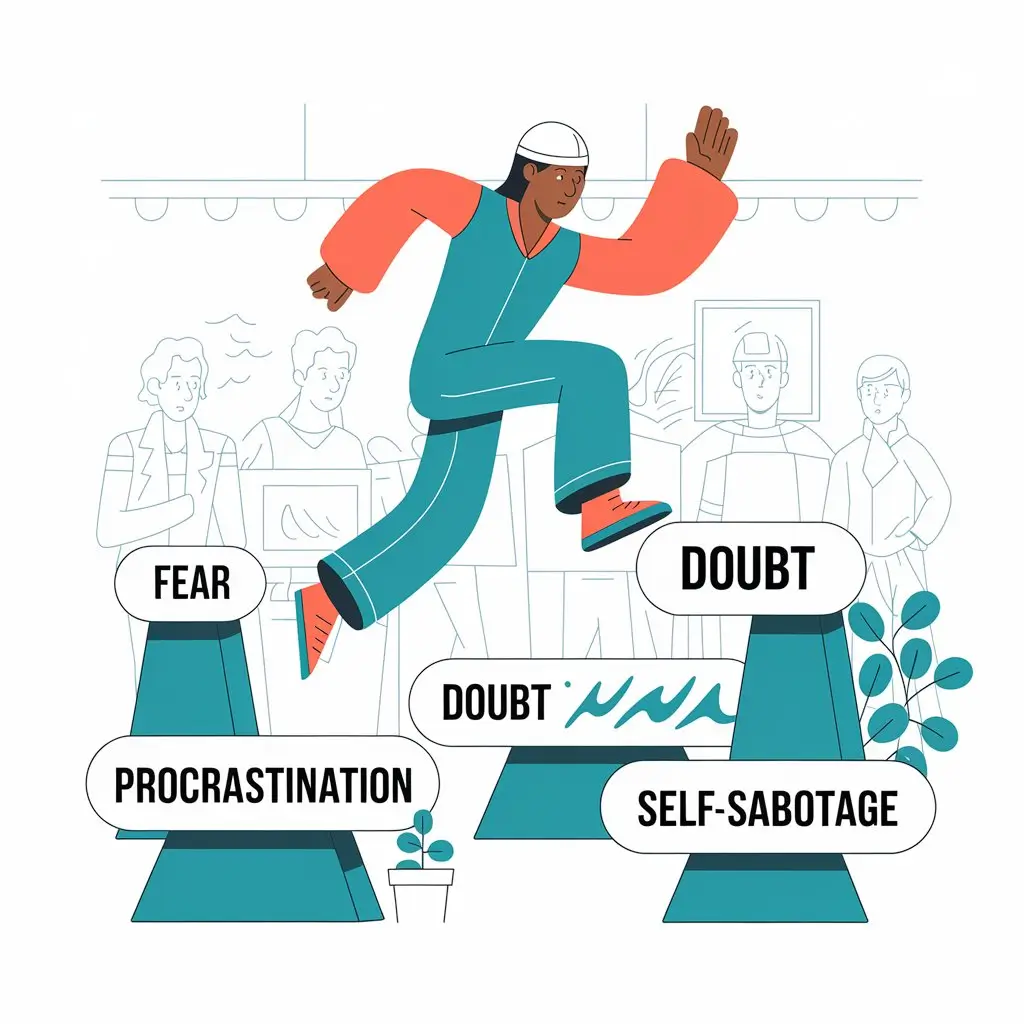
A person jumping over various obstacles labeled with negative thoughts (like "fear," "doubt," "procrastination") to illustrate the challenges of self-sabotage.

Self-sabotage refers to the behaviors and thought patterns that undermine our success and happiness. The different ways humans deal with self-limiting beliefs include procrastinating and speaking negatively to themselves, which ultimately stifles their progress. Understanding these self-defeating behaviors is crucial for personal growth and achieving our goals. This article will explore the nature of self-sabotage, its signs, the cycle it creates, strategies to overcome it, and the importance of support systems in this journey.

Understanding Self-Sabotage

Self-sabotage is a complex phenomenon that involves a range of behaviors and thought patterns that undermine our own success and well-being. It manifests in various forms, often leading us to make choices that hinder our progress rather than promote it. Understanding the nature of self-sabotage is crucial for recognizing its impact on our lives and taking steps to overcome it.

Explanation of Self-Sabotage

At its core, self-sabotage is about actions and beliefs that work against our best interests. Common examples include:

  1. Procrastination: This is one of the most prevalent forms of self-sabotage. Individuals may delay important tasks due to fear of failure, perfectionism, or even a lack of motivation. For instance, someone might put off studying for an important exam, choosing to binge-watch a show instead. This behavior not only increases stress but also leads to poor performance and feelings of regret.
  2. Perfectionism: While striving for excellence can be a positive trait, perfectionism can become self-sabotaging when it leads to unrealistic expectations. Individuals may set such high standards for themselves that they become paralyzed by the fear of not meeting those standards. This often results in inaction, as the individual may prefer to avoid a task altogether rather than risk producing something that falls short of their ideal.
  3. Negative Self-Talk: The internal dialogue we maintain has a profound impact on our self-esteem and motivation. Engaging in negative self-talk, such as telling yourself you’re not good enough or that you’ll fail, can create a self-fulfilling prophecy. This ongoing negativity can erode confidence and lead to further self-sabotaging behaviors.

Psychological Roots of Self-Sabotage

Understanding the psychological roots of self-sabotage can shed light on why individuals engage in these behaviors. Several key factors contribute:

  1. Fear of Failure: Many people fear failure so intensely that they choose to avoid challenges altogether. This fear can stem from past experiences or societal pressures, leading individuals to convince themselves that it’s safer not to try than to risk falling short.
  2. People unexpectedly self-sabotage through their fear of reaching their objectives. Success can bring new responsibilities, expectations, and changes that some individuals may find overwhelming. The thought of living up to new standards can create anxiety, prompting them to undermine their efforts to avoid the perceived stress of success.
  3. Low Self-Esteem and Self-Worth: Individuals with low self-esteem may believe they are unworthy of success or happiness. This belief can manifest as self-sabotaging behavior, as they may actively seek out ways to confirm their negative self-image. Whether through self-criticism or avoidance, these individuals may find themselves trapped in a cycle of self-defeat.
  4. Imposter Syndrome: Many high-achieving individuals experience imposter syndrome, where they doubt their accomplishments and fear being exposed as a fraud. This syndrome can lead to self-sabotage as they may avoid opportunities that could validate their abilities, fearing that they will not live up to expectations.

The Impact of Self-Sabotage

The coSelf-sabotaging behavior has widespread effects that reach different areas of life from personal connections to professional achievements and psychological state. For instance, consistently procrastinating on work projects can lead to job-related stress, missed deadlines, and ultimately, job loss. Relationship self-sabotage takes the form of driving people away while also preventing closeness because of the deep fear of revealing oneself to others.

Signs of Self-Sabotaging Behavior

Recognizing self-sabotaging behaviors is a critical step in overcoming them. These behaviors often manifest in subtle ways, making them easy to overlook or rationalize. By being aware of the signs, individuals can identify patterns that hinder their progress and take proactive steps toward change. Here are some common indicators of self-sabotage:

A photo of a goal or dream (like a graduation cap or travel destination) torn in half, representing how self-sabotage can disrupt aspirations.

Common Indicators

  1. Procrastination:
    • Definition: Procrastination involves delaying tasks that need to be completed, often leading to last-minute stress and subpar results.
    • Examples: An individual may put off studying for an important exam until the night before or delay starting a project at work due to fear of not meeting expectations.
    • Impact: This behavior not only increases anxiety but can also result in missed deadlines, reduced performance, and a cycle of guilt and shame.
  2. Perfectionism:
    • Definition: Perfectionism is the tendency to set excessively high standards for oneself, often leading to dissatisfaction and frustration.
    • Examples: Someone may spend an inordinate amount of time refining a presentation to the point of missing the deadline or avoid submitting work altogether because it doesn’t meet their ideal.
    • Impact: Perfectionism can lead to burnout, as individuals may feel they are never good enough, ultimately stifling creativity and productivity.
  3. Negative Self-Talk:
    • Definition: Negative self-talk involves internal dialogues that undermine confidence and foster self-doubt.
    • Examples: Phrases like “I’m not smart enough” or “I’ll never succeed” are common manifestations of negative self-talk.
    • Impact: This internal narrative can create a self-fulfilling prophecy, where individuals begin to believe they are incapable, leading to further self-sabotaging behaviors.
  4. Avoidance:
    • Definition: Avoidance is the tendency to steer clear of situations or tasks that provoke anxiety or discomfort.
    • Examples: An individual might avoid social gatherings due to fear of judgment or skip important meetings at work to avoid confronting difficult issues.
    • Impact: This can lead to isolation and missed opportunities, reinforcing feelings of inadequacy and anxiety.
  5. Self-Criticism:
    • Definition: Self-criticism involves harshly judging oneself for perceived failures or shortcomings.
    • Examples: An individual may berate themselves for making a mistake or not achieving a goal, often focusing on flaws rather than successes.
    • Impact: This behavior can erode self-esteem and encourage a negative self-image, making it difficult to take risks or pursue new opportunities.
  6. Overcommitment:
    • Definition: Overcommitment refers to taking on too many responsibilities, often as a way to distract from personal issues or fears.
    • Examples: A person might volunteer for multiple projects at work while neglecting their personal needs or goals.
    • Impact: This can lead to burnout, stress, and feelings of being overwhelmed, ultimately hindering both personal and professional growth.

Impact on Personal and Professional Life

The signs of self-sabotaging behavior can significantly affect various aspects of life:

  1. Missed Opportunities: Self-sabotage can lead to hesitance in pursuing new opportunities, whether in career advancement, educational pursuits, or personal relationships. Individuals may find themselves stuck in their current situations, unable to take the necessary steps for growth.
  2. Strained Relationships: Avoidance and negative self-talk can create barriers in personal relationships. Friends and family may feel pushed away, leading to isolation and loneliness. Additionally, perfectionism can cause individuals to set unrealistic expectations for others, resulting in frustration and conflict.
  3. Decreased Motivation: The cycle of self-sabotage can erode motivation over time. Constantly battling negative thoughts and feelings of inadequacy can drain energy and enthusiasm, making it difficult to engage in activities that once brought joy or fulfillment.
  4. People who engage in persistent self-harm behaviors run a greater risk of developing anxiety and depression as mental health conditions. The stress of feeling stuck or inadequate can create a vicious cycle, where individuals feel trapped in their patterns, leading to further emotional distress.

Recognizing and Acknowledging Signs

Awareness is the first step toward breaking free from self-sabotaging behaviors. Keeping a journal to track thoughts and behaviors can help individuals identify patterns and triggers. Reflecting on moments of procrastination, perfectionism, or negative self-talk can illuminate the areas that require attention and change.

The Cycle of Self-Sabotage

Self-sabotage often operates as a cyclical pattern, where one negative behavior reinforces another, creating a loop that can be difficult to escape. People need to grasp the cycle’s dynamics to break unproductive habits along with building a new mentally healthy foundation. Here, we will explore how self-sabotage perpetuates itself and discuss strategies for breaking this damaging cycle.

How Self-Sabotage Perpetuates Itself

  1. Triggering Events:
    • Definition: A triggering event is any situation or experience that provokes an emotional response, often leading to self-sabotaging behavior.
    • Examples: Stressful situations like a looming deadline, a significant life change, or interpersonal conflict can trigger feelings of anxiety or inadequacy.
    • Effect: These triggers can activate negative thought patterns, causing individuals to retreat into self-sabotaging behaviors as a coping mechanism.
  2. Emotional Responses:
    • Definition: Emotional responses are the feelings that arise in reaction to triggering events, which can include anxiety, fear, or frustration.
    • Examples: After receiving critical feedback at work, an individual may feel overwhelmed, prompting them to avoid future challenges or opportunities.
    • Effect: These emotions can reinforce the belief that one is incapable or unworthy, leading to a cycle of avoidance and self-doubt.
  3. Self-Defeating Behaviors:
    • Definition: These are actions taken in response to emotional distress that ultimately hinder one’s progress.
    • Examples: Engaging in procrastination, excessive self-criticism, or withdrawal from social situations can all be forms of self-sabotage.
    • Effect: Such behaviors may provide temporary relief from anxiety but ultimately lead to missed opportunities and increased feelings of guilt or shame.
  4. Reinforcement of Negative Beliefs:
    • Definition: This refers to the process by which self-defeating behaviors reinforce underlying negative beliefs about oneself.
    • Examples: If an individual avoids a job opportunity due to fear of failure, the resulting inactivity reinforces the belief that they are not capable of success.
    • Effect: This reinforces a cycle where negative beliefs lead to further avoidance and self-sabotage, perpetuating the feeling of being stuck.
A vibrant garden in full bloom, representing personal growth and the positive outcomes of breaking free from self-sabotage.

Breaking the Cycle

  1. Recognizing Triggers:
    • Definition: The first step in breaking the cycle is to identify the specific triggers that lead to self-sabotaging behaviors.
    • Examples: Keeping a journal to document situations that provoke anxiety or negative self-talk can help pinpoint patterns.
    • Strategy: Once triggers are recognized, individuals can prepare strategies to address them more constructively.
  2. Developing Self-Awareness:
    • Definition: Self-awareness involves understanding one’s thoughts, feelings, and behaviors, allowing for more intentional responses.
    • Examples: Practicing mindfulness can help individuals become more aware of their emotional responses and thought patterns.
    • Strategy: Mindfulness techniques such as meditation or deep-breathing exercises can reduce anxiety and improve emotional regulation.
  3. Challenging Negative Thoughts:
    • Definition: This involves actively questioning and reframing negative beliefs that contribute to self-sabotage.
    • Examples: Instead of thinking, “I can’t handle this,” individuals can reframe it to, “I can learn and grow from this experience.”
    • Strategy: Cognitive-behavioral techniques can provide tools for challenging and changing these negative thought patterns.
  4. Setting Realistic Goals:
    • Definition: Establishing achievable goals can help individuals break the cycle of self-sabotage by providing clear, manageable steps.
    • Examples: Instead of aiming for perfection, focus on completing a task to the best of one’s ability and celebrating progress.
    • Strategy: Breaking larger tasks into smaller, more manageable parts can make them feel less overwhelming and reduce the temptation to procrastinate.
  5. Seeking Support:
    • Definition: Engaging with friends, family, or professional counselors can provide encouragement and accountability.
    • Examples: Sharing struggles with trusted individuals can offer new perspectives and coping strategies.
    • Strategy: Joining support groups or seeking therapy can create a safe space for discussing challenges and gaining insights from others.

The Importance of Breaking the Cycle

Breaking the cycle of self-sabotage is essential for personal growth and well-being. By addressing the underlying triggers and emotional responses, individuals can begin to replace self-defeating behaviors with more constructive habits. This shift not only fosters resilience but also opens up new opportunities for success and fulfillment.

Strategies to Overcome Self-Sabotage

Overcoming self-sabotage involves several key strategies:

  1. Building self-awareness: Journaling and reflecting on thoughts and behaviors can help identify patterns of self-sabotage. Seeking feedback from trusted friends or mentors can also provide valuable insights.
  2. Reframing negative thoughts: Cognitive restructuring techniques can help challenge and change negative beliefs. Practicing positive affirmations can reinforce a healthier self-image.
  3. Setting realistic goals: Breaking tasks into manageable steps can make them less daunting. Celebrating small achievements along the way fosters a sense of progress and motivation.

The Role of Support Systems

Support systems play a crucial role in overcoming self-sabotage and fostering personal growth. These networks, which can include friends, family, mentors, or professional counselors, provide the encouragement and accountability necessary to challenge self-defeating behaviors. Here’s a deeper look at how support systems can aid in this journey:

Importance of Seeking Help

  1. Emotional Support:
    • Supportive individuals can offer a listening ear and validate feelings, helping to alleviate the isolation often associated with self-sabotage. This emotional connection can provide comfort during challenging times, reminding individuals they are not alone in their struggles.
  2. Perspective and Feedback:
    • Friends and mentors can offer valuable perspectives that individuals may not see themselves. They can help identify self-sabotaging behaviors and suggest alternative approaches, fostering a sense of accountability and motivation to change.
  3. Encouragement to Take Risks:
    • A strong support system can empower individuals to step outside their comfort zones. Encouragement from trusted friends or family can make it easier to pursue opportunities that may feel intimidating, reducing the fear of failure.

Building a Supportive Network

  1. Identifying Positive Influences:
    • It’s important to surround oneself with individuals who uplift and inspire. Reflecting on current relationships can help identify those who contribute positively to personal growth and those who may inadvertently reinforce self-sabotaging behaviors.
  2. Fostering Healthy Relationships:
    • Building and maintaining healthy relationships requires open communication and mutual support. Engaging in honest conversations about struggles and aspirations can strengthen bonds and create a safe space for growth.
  3. Engaging in Group Activities:
    • Participating in group activities, such as support groups or community organizations, can provide a sense of belonging. These environments encourage shared experiences and collective growth, reinforcing the idea that overcoming challenges is a communal effort.

Professional Help

  1. Therapy and Counseling:
    • Seeking professional help can provide specialized tools and strategies to address self-sabotaging behaviors. Therapists can offer insights into the psychological roots of these behaviors and guide individuals in developing healthier coping mechanisms.
  2. Workshops and Seminars:
    • Attending workshops focused on personal development can connect individuals with like-minded peers while providing practical skills to combat self-sabotage. These environments often foster a sense of community and shared purpose.

Conclusion

In summary, self-sabotage is a complex but common issue that can hold us back from achieving our full potential. By recognizing the signs, understanding the cycle, and implementing strategies to overcome these behaviors, we can take proactive steps toward personal growth. Remember, the journey to overcoming self-sabotage is ongoing, and seeking support is a vital part of this process.

Positive Thinking: Why Some Reject Optimism for Negativity

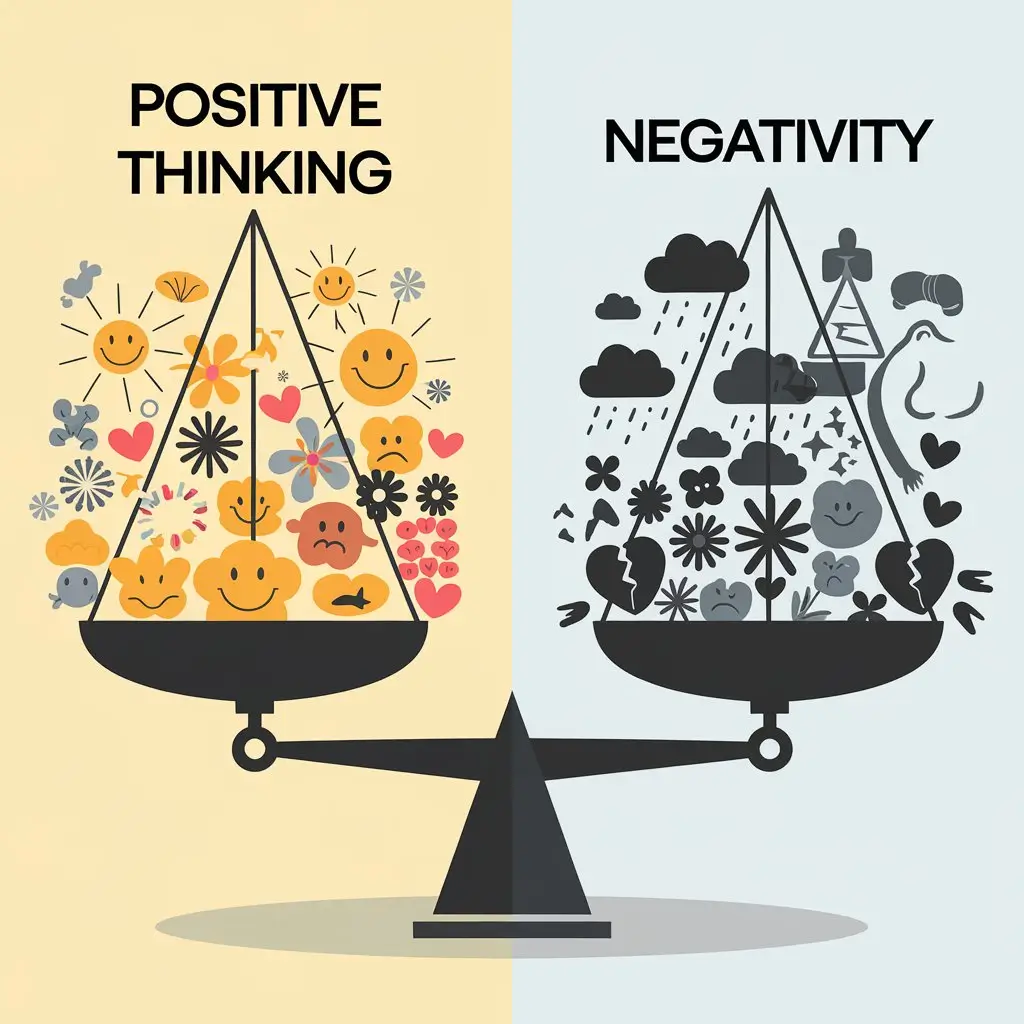
A visual representation of a scale with one side labeled "Positive Thinking" filled with bright, uplifting symbols (like sunshine, smiles, and flowers) and the other side labeled "Negativity" with darker, heavier symbols (like storm clouds, frowns, and broken hearts).

In a world that often champions positivity, it can be perplexing to understand why some individuals reject positive thinking in favor of a more negative outlook. While the benefits of optimism are well-documented, many find solace and comfort in negativity. This article explores the multifaceted reasons behind this phenomenon, delving into psychological, cultural, and personal factors that contribute to the rejection of positive thinking.

Understanding Positive Thinking

Definition of Positive Thinking

Positive thinking is more than just an optimistic outlook; it is a mental attitude that focuses on the bright side of life and anticipates positive outcomes. It involves consciously choosing to view challenges as opportunities for growth rather than insurmountable obstacles. Positive thinkers often practice reframing negative thoughts into constructive ones, enabling them to navigate difficulties with resilience. This mindset is not about ignoring reality or pretending that negative situations don’t exist; rather, it’s about acknowledging those situations while maintaining an overall hopeful perspective.

Benefits of Positive Thinking

The benefits of positive thinking are well-documented across various fields, including psychology, health, and personal development. Research indicates that individuals who adopt a positive mindset tend to experience a range of advantages:

  1. Improved Mental Health: Positive thinking is linked to lower levels of anxiety and depression. By focusing on positive aspects of life, individuals can reduce feelings of hopelessness and despair, leading to better emotional well-being.
  2. Enhanced Resilience: Those who practice positive thinking are often more resilient in the face of adversity. They tend to bounce back more quickly from setbacks, utilizing challenges as learning experiences rather than viewing them as failures.
  3. Better Physical Health: Studies have shown that positive thinkers may experience better physical health outcomes. This includes lower rates of cardiovascular disease, improved immune function, and a longer lifespan. The mind-body connection suggests that a positive attitude can influence overall health.
  4. A positive perspective strengthens motivation and brings about increased drive. When individuals believe that their efforts will lead to positive results, they are more likely to take risks, set ambitious goals, and pursue their passions with vigor.
  5. Stronger Relationships: Positive thinking can enhance interpersonal relationships. Those who maintain an optimistic perspective are often more enjoyable to be around, leading to more robust social connections and support networks.
  6. Greater Life Satisfaction: Ultimately, positive thinkers report higher levels of life satisfaction. By focusing on the good and maintaining hope for the future, they cultivate a sense of fulfillment and contentment, even amidst challenges.

Common Misconceptions about Positive Thinking

Despite its benefits, positive thinking is often misunderstood. Here are some common misconceptions:

  1. Positive Thinking Equals Blind Optimism: Many people equate positive thinking with ignoring reality or being naively optimistic. Positive thinking in its authentic form includes accepting obstacles but selecting solutions and optimistic outcomes.
  2. It’s a Quick Fix: Some believe that adopting a positive attitude will instantly solve their problems. In reality, while positive thinking can create a more constructive mindset, it is not a substitute for action or addressing underlying issues.
  3. Positivity is Always Beneficial: While positivity has its advantages, excessive positivity can lead to toxic positivity, where negative emotions are dismissed or invalidated. It’s essential to strike a balance between embracing positive thoughts and recognizing legitimate feelings of sadness, anger, or frustration.
  4. Anyone Can Just Choose to Be Positive: While adopting a positive mindset is beneficial, it can be challenging for those dealing with mental health issues or significant life stressors. Positive thinking often requires practice and may need to be complemented with professional support or therapy.
An illustration of a brain depicted as a garden. One half is lush and blooming with colorful flowers, representing positive thoughts, while the other half is overrun with weeds and thorns, symbolizing negativity. This visual metaphor can highlight the struggle between nurturing positive thinking and battling negative thoughts.

Techniques for Cultivating Positive Thinking

For those interested in developing a more positive mindset, various techniques can help:

  1. Gratitude Journaling: Regularly writing down things for which you are grateful can shift focus from negative experiences to positive ones, fostering a more optimistic outlook.
  2. Mindfulness Meditation: Practicing mindfulness can help individuals become more aware of their thoughts and feelings, allowing them to challenge negative patterns and cultivate a more positive mindset.
  3. Affirmations: Using positive affirmations can reinforce optimistic beliefs about oneself and one’s future, gradually changing negative self-talk into encouraging messages.
  4. Surrounding Yourself with Positivity: Engaging with positive people, uplifting content, and inspiring environments can enhance your ability to maintain a positive perspective.
  5. Reframing Negative Thoughts: Learning to recognize and reframe negative thoughts into constructive ones can help in developing a more positive outlook on life.

The Appeal of Negativity

Cognitive Dissonance

Cognitive dissonance refers to the mental discomfort experienced when an individual holds two or more contradictory beliefs or values. This psychological phenomenon can lead to significant stress, as people strive to resolve the conflict between their beliefs and their reality. For many, the act of embracing positive thinking can create dissonance. When faced with overwhelming challenges, adopting a positive mindset may feel like denying their lived experiences, leading to a preference for negativity. By rejecting positivity, individuals can alleviate this discomfort, allowing them to align their beliefs with their current emotional state. This alignment can provide a sense of authenticity, as they feel more in tune with their experiences and emotions.

Fear of Disappointment

The fear of disappointment is a powerful motivator that often drives individuals toward a negative outlook. When people set their sights on positive outcomes, they inherently raise their expectations. If these expectations are not met, the resulting disappointment can be emotionally devastating. To protect themselves from this potential pain, many choose to adopt a pessimistic viewpoint, which feels safer and more manageable. By anticipating negative outcomes, they create a psychological buffer that allows them to cope better with life’s inevitable challenges. This approach may lead to a more cautious and measured response to life events, providing a sense of control over their emotional well-being.

Emotional Validation

Negativity often provides a form of emotional validation that can be comforting. When individuals express their frustrations or disappointments, they may find solace in the understanding and empathy of others who share similar feelings. This shared experience reinforces a sense of belonging and community, making it easier to embrace a negative perspective. In contrast, positive thinking can sometimes feel isolating, particularly if one’s social circle or environment does not support or validate this mindset. By engaging in negative discourse, individuals may feel more accepted and understood, which can be a powerful motivator to remain entrenched in negativity.

Avoidance of Vulnerability

Embracing positivity often requires vulnerability, an openness to hope, dreams, and the possibility of failure. For many, this level of vulnerability can be daunting and uncomfortable. By rejecting positive thinking, individuals may feel they are shielding themselves from the emotional risks associated with vulnerability. Maintaining a negative outlook allows them to avoid the potential pain of disappointment and the fear of being judged for their aspirations. This avoidance can create a false sense of security, where individuals feel protected from the uncertainties of life.

Cultural and Societal Influences

Cultural and societal factors play a significant role in shaping attitudes toward negativity. In some cultures, a pragmatic approach that values realism and caution is celebrated over optimism. Individuals raised in these environments may internalize the belief that positivity is naïve or unrealistic. Furthermore, societal narratives often highlight the struggles and challenges people face, reinforcing the idea that negativity is a more authentic and relatable perspective. This cultural backdrop can create a compelling allure for negativity, making it feel more valid and justified than positive thinking.

Identity and Self-Perception

For some individuals, negativity becomes an integral part of their identity. They may see themselves as realists or critical thinkers who understand the complexities of life. This self-perception can lead to a sense of pride in their ability to recognize and articulate the darker aspects of existence. Over time, this identity can become entrenched, making it increasingly difficult to embrace positive thinking. As a result, they may resist any attempts to shift their mindset, viewing such efforts as a threat to their perceived authenticity.

The Role of Social Media

In today’s digital age, social media platforms often amplify negativity. The prevalence of negative news, critical commentary, and pessimistic viewpoints can create an echo chamber that reinforces a negative mindset. Users may find comfort in the shared frustrations and grievances expressed online, leading them to adopt similar attitudes. This environment can normalize negativity, making it feel more acceptable and even necessary in navigating a complex world. The constant exposure to negativity can make it challenging for individuals to seek out or embrace positive perspectives.

Cultural and Social Influences

Cultural Attitudes Towards Positivity

Cultural perspectives significantly shape how individuals view positivity and negativity. In many Western cultures, especially in the United States, there is a strong emphasis on individualism and the idea that one can control their destiny through positive thinking. This cultural narrative promotes the belief that optimism is not only beneficial but also necessary for success. However, in other cultures, particularly in collectivist societies, the value placed on community and shared experiences may lead to a more cautious approach. Here, the focus may be on group harmony and realism, with an understanding that life is filled with challenges and uncertainties. In such contexts, positive thinking may be seen as unrealistic or even harmful, leading individuals to embrace a more pragmatic or negative viewpoint as a way to navigate their social world.

Social Dynamics and Group Identity

Human beings are inherently social creatures, and the dynamics of group identity significantly influence attitudes toward positivity and negativity. Within social groups, shared values and beliefs create a sense of belonging. When negativity is prevalent in a group, be it family, friends, or colleagues, individuals may feel pressured to conform to that mindset to maintain group cohesion. This phenomenon can be particularly pronounced when venting frustrations and sharing negative experiences are normalized. As a result, embracing negativity becomes a way to connect with others, fostering camaraderie through shared struggles and grievances.

The Influence of Language

Language plays a crucial role in shaping thought patterns and perceptions. In cultures where the language emphasizes negative experiences or outcomes, individuals may find it easier to adopt a negative mindset. For example, languages that have a wealth of vocabulary to describe negative emotions or failures may inadvertently encourage speakers to dwell on these aspects. Conversely, cultures that celebrate positive language and expressions of gratitude may foster a more optimistic outlook. The linguistic framework can influence how individuals articulate their experiences, shaping their overall worldview.

An image of a shattered mirror reflecting different emotions. Some shards show happy, positive images while others depict sadness and negativity. This representation can symbolize how perceptions of reality can be fragmented and influenced by cultural and societal factors.

Media Representation

Media, be it news, television, or social media, has a profound impact on societal attitudes. The portrayal of negativity in media often reinforces a pessimistic outlook. News outlets tend to focus on negative events, disasters, and conflicts, as these stories attract more attention and engagement. This constant exposure can create a skewed perception of reality, leading individuals to believe that negativity is more prevalent than positivity. Additionally, social media platforms often amplify negative sentiments, as users tend to share grievances and frustrations more frequently than positive experiences. This environment cultivates a culture where negativity feels more normalized and prevalent.

Historical Context

Historical events also shape cultural attitudes toward positivity and negativity. Societies that have experienced significant turmoil, such as wars, economic crises, or political oppression, may develop a collective mindset that prioritizes caution and skepticism. In these contexts, positivity may be viewed as naïve, while negativity becomes a form of realism that acknowledges the harsh truths of life. The collective memory of hardship can influence the values and beliefs passed down through generations, perpetuating a cycle of negativity.

Generational Differences

Different generations may have varying attitudes toward positivity and negativity, influenced by the unique challenges and contexts they face. For example, older generations who lived through significant economic downturns or wars may have a more cautious outlook compared to younger generations who may have been raised in more stable environments. The rise of social media and the internet has also shaped how younger individuals perceive positivity and negativity, often leading to a blend of optimism and skepticism. Understanding these generational differences can provide insight into the broader cultural landscape regarding attitudes toward positivity.

The Role of Education

Education systems also play a crucial role in shaping attitudes toward positivity and negativity. Schools that emphasize social-emotional learning and resilience training can foster a more positive mindset among students. Conversely, educational environments that focus solely on standardized testing and achievement may inadvertently promote a culture of competition and negativity, where failure is stigmatized. The values instilled in students during their formative years can have lasting effects on their attitudes and behaviors as adults.

Personal Experiences and History

Impact of Past Negative Experiences

Past disappointments significantly shape current attitudes. Individuals who have faced repeated setbacks may adopt a pessimistic outlook as a protective measure, believing it to be more realistic than positivity.

The Role of Trauma and Adversity

Trauma can profoundly influence one’s worldview. Those who have experienced significant adversity may find it difficult to embrace positivity, viewing it as an oversimplification of their complex experiences.

Psychological Mechanisms

Negativity Bias

Negativity bias refers to the tendency for individuals to focus more on negative experiences than positive ones. This bias has evolutionary roots, as recognizing threats was crucial for survival. As a result, negativity can feel more instinctive and comforting.

B. Defense Mechanisms

Psychological defense mechanisms, such as rationalization and denial, often promote negativity. These mechanisms can help individuals cope with uncomfortable emotions but may also hinder their ability to embrace positive thinking.

Perception of Positivity

Naïveté vs. Realism

Many individuals perceive positivity as naïve, believing it overlooks the complexities and difficulties of life. This skepticism often leads to a rejection of positive thinking in favor of a more grounded approach.

Skepticism of Self-Help Culture

The rise of self-help movements has led some to view positivity as superficial or “fluff.” This skepticism can reinforce negative attitudes, as individuals dismiss tools that promote optimism.

The Comfort of Negativity

Emotional Validation

Negativity can provide emotional validation. When people express frustrations or disappointments, they often feel understood and supported by others who share similar feelings, reinforcing their attachment to negative thinking.

Avoiding Change and Discomfort

Embracing positive thinking often requires change, which can be uncomfortable. By rejecting positivity, individuals may avoid the discomfort associated with personal growth and transformation.

Navigating the Balance

The Importance of a Balanced Perspective

While negativity can feel comforting, it is essential to find a balance. Integrating both positive and negative thinking can lead to a more nuanced understanding of life and its challenges.

Strategies for Cultivating a Healthier Mindset

To foster a healthier mindset, individuals can practice mindfulness, engage in self-reflection, and seek support from others. These strategies can help them acknowledge negative feelings while also embracing positivity.

Conclusion

In conclusion, the rejection of positive thinking in favor of negativity is a complex issue influenced by cognitive, cultural, and personal factors. Understanding these dynamics can provide valuable insights into human behavior and mental health. By exploring personal attitudes towards positivity and negativity, individuals may find opportunities for growth and a more balanced approach to life. Ultimately, embracing both perspectives can lead to a richer and more fulfilling existence

Confidence vs. Arrogance: Tips for Building Healthy Confidence

A side-by-side comparison of two individuals engaged in a conversation. One person appears open and relaxed, showing confidence, while the other looks closed off or dismissive, representing arrogance.

In today’s fast-paced world, the concepts of confidence and arrogance often become intertwined, leading to confusion about what it truly means to have self-assurance. While confidence is a vital trait that can enhance our lives and relationships, arrogance can lead to isolation and missed opportunities. Understanding the difference between these two traits is crucial for personal development and healthy interactions. This article aims to differentiate between genuine self-confidence and arrogance, encouraging readers to cultivate authentic self-assurance while remaining humble and open to feedback.

Understanding Confidence

Genuine self-confidence is not merely a facade; it is a deep-seated belief in one’s abilities and worth. Understanding its key characteristics can help individuals recognize and cultivate this essential trait.

  1. Self-Awareness:
    Self-awareness is the cornerstone of confidence. Confident individuals possess a clear understanding of their strengths, weaknesses, values, and beliefs. This awareness enables them to set realistic goals and make informed decisions. By regularly reflecting on their experiences and emotions, self-aware individuals can recognize areas for improvement without diminishing their self-worth. This balanced perspective allows them to embrace challenges and learn from failures as part of their growth journey.
  2. Positive Self-Image:
    A positive self-image is crucial for true confidence. This does not mean ignoring imperfections or flaws; rather, it involves accepting oneself fully while recognizing one’s potential. Confident individuals focus on their unique qualities and achievements instead of comparing themselves unfavorably to others. They celebrate their individuality and understand that everyone has different strengths and weaknesses. This self-acceptance leads to greater resilience, as they are less likely to be shaken by criticism or setbacks.
  3. Ability to Take Risks:
    Confident people choose to move beyond their familiar boundaries. Those who are genuinely confident view challenges as opportunities for growth rather than threats. They are willing to take calculated risks, understanding that failure is often a stepping stone to success. This willingness to embrace uncertainty fosters creativity and innovation, allowing them to explore new ideas and experiences. By taking risks, confident individuals expand their skill sets and develop a broader perspective on life.
  4. Resilience in the Face of Adversity:
    A person’s resilience levels depend directly on their self-confidence. People with confidence demonstrate better capability to tackle challenges that stand in their way. People with resilience understand that problems are momentary in nature while keeping an optimistic frame of mind during hard times. People who demonstrate resilience do so because they have faith in their capabilities while they persist toward personal advancement. Instead of succumbing to despair, they analyze situations, learn from their experiences, and adapt their strategies accordingly. This mindset not only helps them overcome difficulties but also inspires others around them.
  5. Empathy and Connection:
    Genuine self-confidence often goes hand in hand with empathy. Those who maintain confidence establish emotional relationships with others. They understand that everyone struggles and that vulnerability is a part of the human experience. This empathy allows them to build meaningful relationships, as they can offer support and encouragement to others. By fostering connections, they create a positive environment where collaboration and mutual respect thrive.

Benefits of Confidence

The advantages of cultivating genuine self-confidence extend beyond personal well-being; they positively impact various aspects of life.

  1. Improved Decision-Making:
    Confident individuals trust their judgment and are more decisive. They analyze situations calmly, weigh their options, and make choices that align with their values and goals. This decisiveness reduces anxiety and promotes a proactive approach to challenges, allowing them to navigate life’s complexities with clarity and purpose.
  2. Enhanced Relationships:
    Confidence fosters healthy relationships built on trust and respect. Confident individuals communicate openly and assertively, expressing their needs and opinions without fear. This openness encourages others to do the same, creating an atmosphere of mutual understanding. As a result, relationships become deeper and more meaningful, marked by genuine connection and support.
  3. Greater Resilience in Challenges:
    Confidence equips individuals with the tools to face adversity head-on. When confronted with challenges, confident individuals are more likely to remain calm and composed, viewing obstacles as opportunities to learn and grow. Their resilience enables them to bounce back from setbacks, maintaining a positive attitude that inspires those around them.
  4. Increased Motivation and Goal Achievement:
    Confidence fuels motivation. When individuals believe in their abilities, they are more likely to set ambitious goals and pursue them persistently. This motivation stems from a desire to prove to themselves that they can achieve success. As they achieve their goals, their confidence grows, creating a positive feedback loop that propels them forward.
  5. Positive Impact on Mental Health:
    Genuine self-confidence contributes to overall mental well-being. Confident individuals are less likely to experience anxiety and self-doubt. They approach challenges with a growth mindset, reducing the fear of failure. This positive outlook fosters resilience and emotional stability, leading to a healthier mental state.

The Role of Self-Reflection in Building Confidence

Self-reflection is a powerful tool for cultivating confidence. By regularly assessing their thoughts, feelings, and behaviors, individuals can identify areas for growth and development. Journaling, meditation, and seeking feedback from trusted friends or mentors can enhance self-awareness and reinforce positive self-perception.

Exploring Arrogance

Arrogance often masquerades as confidence, creating confusion and misunderstandings in personal and professional interactions. Understanding the characteristics and consequences of arrogance is essential for recognizing its impact on relationships and personal growth.

Characteristics of Arrogance

  1. Overestimation of Abilities:
    Arrogant individuals frequently exhibit an inflated sense of self-worth, believing they possess superior skills or knowledge compared to others. This overestimation can lead to unrealistic expectations, both for themselves and for those around them. They may take on tasks beyond their capabilities, resulting in failure and disappointment, yet they often refuse to acknowledge their limitations. This mindset not only hinders personal growth but can also alienate colleagues and friends who may feel overshadowed or undervalued.
  2. Dismissiveness of Others:
    A hallmark of arrogance is the tendency to dismiss or belittle the opinions and contributions of others. Arrogant individuals may interrupt conversations, ignore suggestions, or offer condescending feedback. This behavior stems from a belief that their thoughts and ideas are inherently superior. Such dismissiveness creates an environment where collaboration is stifled, and team members may feel reluctant to share their insights, fearing ridicule or rejection. Over time, this undermines trust and respect within relationships.
  3. Lack of Accountability:
    Arrogance often manifests in a refusal to take responsibility for one’s actions. Arrogant individuals may deflect blame onto others or external circumstances when things go wrong. This lack of accountability stems from a desire to maintain their inflated self-image. Instead of learning from mistakes and seeking ways to improve, they may double down on their beliefs, further entrenching their arrogance. This behavior not only stunts personal development but can also lead to resentment among peers who feel unjustly blamed.
  4. Closed-Mindedness:
    Arrogant individuals typically display a reluctance to consider alternative viewpoints or accept constructive criticism. They may perceive any challenge to their ideas as a personal attack, leading to defensiveness and hostility. This closed-mindedness prevents them from learning and evolving, as they miss out on valuable insights that could enhance their understanding and skills. Over time, this rigidity can lead to stagnation, both personally and professionally.
  5. Superficial Charm:
    While arrogance is often characterized by negative traits, some arrogant individuals may possess a superficial charm that initially draws people in. They may be charismatic and engaging in social settings, using their charm to dominate conversations. However, this charm is often a veneer that hides their underlying arrogance. Once people see through this facade, they may feel manipulated or deceived, leading to disillusionment and a breakdown of relationships.
An individual looking in a mirror, representing self-awareness and genuine confidence. The reflection could show a positive self-image, contrasting with a distorted or exaggerated image representing arrogance.

Consequences of Arrogance

  1. Damaged Relationships:
    The dismissive and condescending behavior associated with arrogance can lead to significant strain in personal and professional relationships. Colleagues may feel disrespected, leading to a breakdown in communication and collaboration. Friends may distance themselves from arrogant individuals, feeling undervalued and frustrated. Over time, these damaged relationships can result in isolation, as arrogant individuals find it increasingly difficult to connect with others.
  2. Missed Opportunities for Growth:
    Arrogance can hinder personal and professional development by closing off avenues for learning. When individuals dismiss feedback or refuse to acknowledge their weaknesses, they miss out on valuable opportunities to improve. This stagnation can lead to a lack of progress in their careers or personal lives, as they fail to adapt to changing circumstances or learn from their experiences.
  3. Isolation from Feedback and Collaboration:
    Arrogant individuals often create an environment where collaboration is stifled. Their dismissive attitude towards others can deter team members from sharing ideas, leading to a lack of innovation and creativity. This isolation can also extend to feedback; when others feel that their contributions will be disregarded, they are less likely to offer constructive criticism. Consequently, arrogant individuals may find themselves surrounded by yes-men, receiving only superficial affirmation rather than honest input.
  4. Negative Impact on Mental Health:
    While arrogance may be perceived as a sign of strength, it often masks underlying insecurities. Arrogant individuals may experience chronic stress and anxiety, stemming from the pressure to maintain their inflated self-image. This internal conflict can lead to feelings of isolation and disconnection, exacerbating mental health issues. Over time, the lack of genuine relationships and the inability to confront personal flaws can contribute to a downward spiral of self-esteem and well-being.
  5. Professional Consequences:
    In the workplace, arrogance can severely impact career advancement. Leaders who display arrogant behavior may struggle to foster effective teams, leading to decreased productivity and morale. Furthermore, their inability to accept feedback may result in poor decision-making and a lack of adaptability in a rapidly changing environment. Over time, this can hinder career progression, as colleagues and superiors may seek to distance themselves from arrogant individuals.

Key Differences Between Confidence and Arrogance

Understanding the key differences between confidence and arrogance is essential for personal growth and fostering healthy relationships. While both traits may appear similar at first glance, their underlying attitudes, behaviors, and impacts on others set them apart.

Attitude Towards Oneself

  1. Self-Perception:
    • Confidence: Confident individuals possess a realistic and balanced view of themselves. They recognize their strengths and accomplishments while also accepting their weaknesses and areas for improvement. This self-awareness allows them to approach challenges with a sense of optimism and resilience.
    • Arrogance: In contrast, arrogant individuals often have an inflated self-perception. They see themselves as superior to others and may downplay their limitations. This skewed view can lead to overconfidence, where they take on challenges beyond their abilities, often resulting in failure.
  2. Response to Failure:
    • Confidence: When faced with setbacks, confident individuals are more likely to reflect on the situation, learn from their mistakes, and adapt their strategies. They view failure as a learning opportunity rather than a reflection of their self-worth.
    • Arrogance: Arrogant individuals often struggle to accept failure. Instead of taking responsibility, they may blame external factors or other people. This avoidance behavior prevents growth and can lead to repeated mistakes.

Attitude Towards Others

  1. Respect and Consideration:
    • Confidence: Confident individuals respect and value the opinions and contributions of others. They engage in active listening and encourage collaboration, recognizing that diverse perspectives can enhance decision-making and creativity.
    • Arrogance: Arrogant individuals often dismiss or belittle the ideas and insights of others. They may interrupt conversations or speak over people, creating an environment where others feel undervalued. This lack of respect can lead to resentment and hinder teamwork.
  2. Encouragement vs. Dismissiveness:
    • Confidence: Confident individuals uplift and encourage those around them. They celebrate the successes of others and offer support, fostering a positive atmosphere that promotes growth and collaboration.
    • Arrogance: Arrogant individuals often exhibit dismissiveness, believing that their opinions are the only ones that matter. This attitude can create a toxic environment where others feel discouraged from sharing their thoughts or contributions.

Openness to Learning and Feedback

  1. Receptiveness to Criticism:
    • Confidence: Confident individuals are open to constructive criticism. They view feedback as an opportunity for improvement and actively seek input from others to refine their skills and approaches. This openness fosters a growth mindset and encourages continuous learning.
    • Arrogance: Arrogant individuals often react defensively to feedback. They may perceive criticism as a personal attack, leading to hostility or withdrawal. This closed-mindedness limits their potential for growth and alienates those who wish to help.
  2. Continuous Improvement:
    • Confidence: Confident individuals prioritize personal development. They regularly assess their skills and seek out opportunities to learn and grow. This commitment to self-improvement enhances their capabilities and expands their horizons.
    • Arrogance: In contrast, arrogant individuals may believe they have nothing left to learn. This complacency can lead to stagnation, as they miss out on valuable opportunities for growth and development. Their unwillingness to evolve can be detrimental to both their personal and professional lives.

Impact on Relationships

  1. Building Trust and Respect:
    • Confidence: Confident individuals naturally build trust and respect in their relationships. Their authenticity and openness encourage others to engage with them genuinely. This trust fosters deeper connections and collaboration, enhancing both personal and professional interactions.
    • Arrogance: Arrogant individuals often struggle to build trust. Their dismissive behavior and inflated self-image can create barriers in relationships. Over time, this erosion of trust can lead to isolation, as others may feel uncomfortable or undervalued in their presence.
  2. Influence on Group Dynamics:
    • Confidence: In group settings, confident individuals often emerge as natural leaders. Their ability to inspire and motivate others fosters a positive team dynamic where everyone feels valued and heard. This collaborative spirit enhances productivity and creativity.
    • Arrogance: Arrogant individuals can disrupt group dynamics. Their tendency to dominate conversations and dismiss others’ contributions can lead to frustration and disengagement among team members. This negative influence can stifle innovation and hinder overall group effectiveness.

Cultivating Healthy Self-Confidence

Building and maintaining healthy self-confidence is a lifelong journey that requires intentional effort and self-reflection. By implementing specific strategies and practices, individuals can nurture their confidence while ensuring it remains grounded in humility and self-awareness. Here are key approaches to cultivating healthy self-confidence.

Strategies for Building Self-Confidence

  1. Setting and Achieving Realistic Goals:
    Setting achievable goals is fundamental to building self-confidence. Start by breaking larger aspirations into smaller, manageable tasks. This approach allows for incremental progress and provides opportunities for celebration along the way. Each small success reinforces a sense of capability and accomplishment. For instance, if your goal is to improve public speaking skills, begin by practicing in front of a mirror, then progress to small group settings before addressing larger audiences.
  2. Practicing Self-Compassion:
    During challenging circumstances, self-compassion requires expressing kindness and understanding to your own self. Acknowledge human imperfection by forgiving yourself following failures as you forgive others for their mistakes. This compassionate approach fosters resilience and helps maintain a positive self-image. Techniques such as mindfulness meditation can enhance self-compassion, allowing you to acknowledge your feelings without judgment and promoting a healthier mental state.
  3. Embracing Vulnerability:
    Embracing vulnerability is a powerful way to build confidence. It involves acknowledging your fears and insecurities and being open about them with trusted individuals. Sharing your struggles can create deeper connections with others and reinforce the idea that vulnerability is a strength, not a weakness. Your willingness to share creates an environment where others will express their support which builds up your self-esteem.
  4. Challenging Negative Self-Talk:
    Internal negative statements often cause major challenges for achieving self-confidence. Take note of the conversations happening inside your mind to deactivate any doubting or critical thoughts. Use this opportunity to create strong positive statements which reflect everything you can do well. You should change your thoughts from “I can’t do this” to “I possess the capabilities necessary for learning along with improvement.” Writing down achievements and positive affirmations in a journal enables you to reference your strengths during difficult situations.
  5. Engaging in Continuous Learning:
    Confidence grows with knowledge and skill development. Embrace a mindset of continuous learning by seeking opportunities to acquire new knowledge and skills. This could include taking courses, attending workshops, or simply reading books related to your interests or profession. The more competent you become in your chosen areas, the more confident you will feel in your abilities. Additionally, this commitment to learning demonstrates humility and a desire for growth, further reinforcing healthy self-confidence.
A side-by-side comparison of two individuals engaged in a conversation. One person appears open and relaxed, showing confidence, while the other looks closed off or dismissive, representing arrogance.

Importance of Humility

  1. Acknowledging Limitations:
    A key aspect of healthy self-confidence is recognizing and accepting your limitations. Understand that no one is perfect and that everyone has areas for improvement. By acknowledging where you may need growth, you can set realistic expectations for yourself and focus on continuous development. This humility allows for a more grounded sense of self-worth, as it is not solely based on achievements but also on the understanding of your journey.
  2. Valuing Others’ Contributions:
    Healthy self-confidence also involves appreciating the strengths and contributions of others. Recognize that everyone has unique talents and perspectives that can enrich your experiences and knowledge. By valuing collaboration and teamwork, you not only foster positive relationships but also create an environment where everyone feels empowered to share their insights. This collaborative spirit enhances your confidence as you engage with diverse viewpoints and ideas.
  3. Seeking Constructive Criticism:
    Individuals must welcome beneficial critiques to develop as people. Actively seek feedback from trusted friends, mentors, or colleagues who can provide honest insights into your strengths and areas for improvement. Approach this feedback with an open mind, viewing it as a tool for growth rather than a personal attack. By embracing constructive criticism, you demonstrate humility and a commitment to self-improvement, which in turn bolsters your confidence.

Building a Supportive Environment

  1. Surrounding Yourself with Positive Influences:
    The people with whom you socialize have a notable effect on your self-confidence. Surround yourself with supportive individuals who uplift and encourage you. Positive influences can help reinforce your self-worth and inspire you to pursue your goals. Engage with friends, mentors, and colleagues who celebrate your successes and provide constructive feedback when needed.
  2. Creating a Safe Space for Growth:
    Foster an environment where you feel safe to express yourself and take risks. Attending supportive communities represented by groups or workshops that promote personal development would be a useful example. In these spaces, you can share experiences, learn from others, and receive encouragement. A safe environment allows you to experiment and grow without fear of judgment, further enhancing your confidence.
  3. Practicing Gratitude:
    Regularly practicing gratitude can significantly boost your self-confidence. Devote daily moments to recognize those aspects which you value about your existence and personal qualities. This practice shifts your focus from what you lack to what you have, reinforcing a positive self-image. Keeping a gratitude journal can serve as a reminder of your achievements, strengths, and the support you receive from others.

Recognizing and Addressing Arrogance

Self-Reflection Exercises to Identify Arrogance

  1. Journaling for Self-Awareness:
    Maintaining a journal proves itself to be a strong instrument for personal introspection. Regularly write about your interactions with others, noting moments where you may have been dismissive, overly critical, or resistant to feedback. Reflect on how these behaviors might have affected your relationships and the overall dynamics in your personal and professional life. Over time, patterns will emerge, allowing you to identify areas where arrogance may be manifesting.
  2. Soliciting Honest Feedback:
    Engage trusted friends, family members, or colleagues in open conversations about your behavior. Ask for their honest opinions regarding your interactions and attitude. Frame the conversation in a way that encourages constructive criticism, making it clear that you are seeking to grow. Open your mind towards listening to their point of view regardless of the uncomfortable nature of the discussion. Their insights can provide valuable clarity on how you may come across to others.
  3. Mindfulness Practices:
    Mindfulness practices, such as meditation or deep breathing exercises, can help increase self-awareness. By cultivating a present-moment focus, you can better observe your thoughts and reactions in real time. This heightened awareness can help you recognize dismissive or arrogant tendencies as they arise, allowing you to address them immediately instead of letting them fester.
  4. Evaluating Responses to Feedback:
    Pay attention to how you respond to feedback, both positive and negative. If you find yourself becoming defensive or dismissive when receiving constructive criticism, this may indicate an arrogant mindset. Acknowledging these reactions is a critical step in addressing arrogance and shifting towards a more open and growth-oriented perspective.

Strategies to Overcome Arrogant Tendencies

  1. Active Listening:
    One of the most effective ways to counteract arrogance is by practicing active listening. Focus on truly hearing what others are saying without formulating a response in your mind while they speak. You should request clarification and display authentic interest about their point of view. This practice fosters respect and appreciation for others’ insights, helping to create a more collaborative environment.
  2. Cultivating Empathy:
    Developing empathy is essential for overcoming arrogance. Make a conscious effort to understand the feelings and viewpoints of others. Put yourself in their shoes and consider how they might perceive your behavior. This practice can lead to greater compassion and reduce the tendency to dismiss others’ contributions. Engaging in empathy-building exercises, such as volunteering or participating in group discussions, can enhance your ability to connect with others on a deeper level.
  3. Practicing Gratitude:
    Regularly expressing gratitude can shift your focus from yourself to the contributions of others. Keep a gratitude journal where you note the positive qualities and efforts of those around you. Acknowledging the value others bring to your life reinforces humility and appreciation, counterbalancing any tendencies toward arrogance. By fostering a mindset of gratitude, you cultivate a greater sense of connection and respect for those around you.
  4. Embracing Humility in Success:
    When you achieve success, take time to reflect on the contributions of others who helped you along the way. Acknowledge your team members, mentors, and anyone else who played a role in your accomplishments. Celebrating collective success fosters a sense of shared achievement and counters any inclination to inflate your self-importance. This practice reinforces the idea that success is often a collaborative effort rather than an individual triumph.
  5. Setting Growth-Oriented Goals:
    Shift your focus from proving your superiority to cultivating your skills and knowledge. Set specific, measurable, achievable, relevant, and time-bound (SMART) goals that emphasize personal development rather than comparison with others. By concentrating on your growth journey, you reduce the tendency to engage in arrogant behaviors and foster a mindset rooted in continuous improvement.
  6. Engaging in Collaborative Activities:
    Participate in team-based projects or community service initiatives that require collaboration and cooperation. Engaging with others in a shared goal helps you appreciate diverse perspectives and skills. This collaborative spirit counters arrogance and reinforces the value of teamwork, enhancing your understanding of the importance of others in achieving collective success.

Building a Support System

  1. Surrounding Yourself with Honest Individuals:
    Create a network of friends, mentors, or colleagues who are willing to provide honest feedback. Engage with people who challenge your perspectives and encourage growth. This support system can help keep you grounded and provide accountability as you work to overcome arrogant tendencies.
  2. Participating in Support Groups or Workshops:
    Consider joining support groups or workshops focused on personal development and emotional intelligence. These environments provide opportunities to explore your behavior in a safe space, interact with others, and receive constructive feedback. Engaging with like-minded individuals can inspire you to cultivate humility and self-awareness.
  3. Seeking Professional Help:
    If you find it challenging to recognize or address your arrogance, consider seeking guidance from a therapist or coach. Professionals can provide tailored strategies and insights to help you navigate your journey toward greater self-awareness and balanced self-confidence. They can also assist in addressing underlying issues that may contribute to arrogant behavior.

Conclusion

Balancing confidence and humility is crucial for personal and professional success. By cultivating genuine self-assurance while remaining open to feedback, individuals can navigate life with a healthy self-perception. Reflect on your own self-image and strive to embrace the confidence that empowers you, while also valuing the perspectives of those around you.

Starting Over: Strategies to Overcome Fear and Thrive

A climber triumphantly standing on a mountain peak, illustrating the achievement and resilience involved in overcoming challenges.

Starting over can be one of the most daunting experiences in life. Whether it’s a career change, a move to a new city, or a personal reinvention, the fear of the unknown often holds us back. However, embracing change as a new beginning can lead to incredible opportunities for growth. In this article, we will explore the fear associated with starting over, the benefits of embracing change, effective strategies to overcome fear, inspiring stories of reinvention, and practical exercises to help you embrace new beginnings.

Understanding the Fear of Starting Over

Definition of Fear of Starting Over

The fear of starting over is a psychological response to the prospect of change, whether it’s a career shift, a move to a new location, or a significant life transformation. It encapsulates a range of emotions, including anxiety, uncertainty, and self-doubt. Many people find themselves paralyzed by the thought of leaving their comfort zones, worrying about what they might lose rather than what they might gain.

This fear often includes several components:

  • Fear of Failure: The prospect of not succeeding in a new environment can be intimidating. Many individuals worry that they will not measure up to the challenges ahead or that they will fail to meet their own expectations.
  • Fear of the Unknown: Stepping into the unknown opens up a realm of possibilities, but it also invites uncertainty. The lack of clarity about what lies ahead can be overwhelming, leading to anxiety about potential outcomes.
  • Fear of Judgment: People often worry about how others will perceive their decision to start over. Concerns about disappointing family or friends, or facing criticism, can add an additional layer of stress.

The Psychological Impact of Change

Change is inherently stressful, and it can trigger a range of psychological responses. The fear of starting over can lead to:

  • Anxiety: The anticipation of change can create feelings of anxiety, which may manifest as restlessness, worry, or even physical symptoms like a racing heart or difficulty sleeping. This anxiety can be compounded by the fear of not knowing how to navigate the new situation.
  • Self-Doubt: Starting over often forces individuals to confront their insecurities. They may question their abilities, skills, and worthiness, leading to a diminished self-esteem. This self-doubt can become a self-fulfilling prophecy, causing them to hesitate or second-guess their decisions.
  • Stress and Burnout: The emotional toll of fearing change can lead to stress and burnout, making it harder to function in daily life. When the mind is preoccupied with worries about the future, it can become challenging to focus on present responsibilities and opportunities.

Recognizing and Validating Your Feelings

Acknowledging that fear is a natural part of the process is crucial. Everyone experiences fear when faced with significant change, and recognizing this can help normalize the feelings of anxiety and doubt. Accepting these emotions as valid responses to uncertainty can create space for healing and growth.

The Importance of Self-Reflection

Understanding the root causes of your fear can be an illuminating process. Self-reflection allows you to explore questions such as:

  • What specific aspects of starting over frighten me the most?
  • Are my fears based on past experiences, or are they projections of my anxieties?
  • I have previously demonstrated success in handling changes throughout different stages of my life.

By answering these questions, you can gain insight into your emotional landscape and begin to deconstruct the barriers that are holding you back. This clarity can empower you to take actionable steps toward overcoming your fears and embracing the possibilities that come with starting over.

The Benefits of Embracing Change

New Opportunities for Growth

Change often serves as a catalyst for growth. When you step outside your comfort zone, you open yourself up to experiences that challenge your existing beliefs and skills. This can lead to:

  • Skill Development: Starting over usually requires you to learn new skills or refine existing ones. Whether it’s adapting to a new job, learning a new language, or picking up a hobby, each experience contributes to your personal and professional toolkit.
  • Broadened Perspectives: Embracing change exposes you to diverse environments and people. These interactions can challenge your worldview, prompting you to think critically and adapt to new ideas. This broadened perspective can enhance your creativity and problem-solving abilities.
  • Expanded Network: New beginnings often come with opportunities to meet new people. Building relationships with colleagues, mentors, or fellow enthusiasts can lead to valuable connections that benefit your personal and professional life.

Building Resilience

Having resilience means you can recover from loss combined with adapting to environmental changes. Embracing new beginnings functions as a strong approach to develop essential resilience abilities:

  • Your resilience grows stronger with every encounter you survive between fears and challenges you face in life. This process teaches you how to navigate difficulties with grace and confidence, preparing you for future challenges.
  • Enhanced Coping Skills: Starting over involves learning how to manage uncertainty and stress. As you navigate the ups and downs of change, you develop coping strategies that can be applied in various aspects of your life, making you more adaptable and resourceful.
  • Your self-assurance will rise when you manage to handle a fresh start successfully. Your achieved small goals create accomplishments which boost your confidence for handling upcoming changes.

Improved Mental Well-Being

Embracing change can have a positive impact on your mental health. It helps break the monotony of routine and can lead to:

  • Increased Happiness: Engaging in new experiences can reignite your passion for life. Your life becomes more exciting as you accept changes because new interests reveal while you meet diverse people who help uncover unfamiliar parts of yourself.
  • An original stressful reaction to change typically results in a life with better fulfillment. Routine eventually loses its freshness which makes changes become refreshing restarts that eliminate boring or stagnant feelings.
  • Mindfulness and Presence: The process of starting over often demands that you focus on the present moment. Your deep involvement with new surroundings leads to mindfulness development resulting in better overall well-being.

Opportunities for Reinvention

Starting over offers a unique chance for self-reinvention. It allows you to redefine your identity and pursue paths that genuinely resonate with you:

  • Clarifying Values and Goals: Change often prompts introspection. As you navigate new beginnings, you may discover what truly matters to you, leading to a clearer sense of purpose and direction in life.
  • Pursuing Passions: Embracing change can provide the freedom to explore passions you may have set aside. Whether it’s starting a new career, picking up a long-neglected hobby, or traveling, these pursuits can lead to a more satisfying and enriched life.
  • Creating a New Narrative: Each new beginning allows you to rewrite your personal story. You can choose to leave behind limiting beliefs and embrace a narrative that reflects your aspirations and dreams.
A beautiful sunrise illuminating a peaceful landscape, symbolizing new beginnings and hope for the future.

Strategies for Overcoming Fear

Acknowledge Your Feelings

The first step in overcoming fear is to acknowledge and accept your emotions. Denying or suppressing your feelings can lead to increased anxiety and stress. Instead, consider the following:

  • Recognize Your Fear: Take time to identify what specifically scares you about starting over. Is it the fear of failure, uncertainty, or judgment? Understanding the root of your fear is essential for addressing it.
  • Validate Your Emotions: Remind yourself that it’s normal to feel fear when facing significant changes. Accepting your feelings as valid can help alleviate guilt or shame associated with them.
  • Express Yourself: Journaling can be a powerful tool for processing your emotions. Write about your fears, concerns, and hopes related to the change. This exercise can provide clarity and help you articulate your feelings more effectively.

Shift Your Mindset

Reframing your thoughts is a powerful strategy for overcoming fear. By altering your perspective, you can transform anxiety into motivation:

  • Focus on Growth Opportunities: Instead of viewing starting over as a potential failure, consider it an opportunity for growth. Reflect on what you can learn from this experience and how it can contribute to your personal development.
  • Embrace a Positive Narrative: Challenge negative self-talk by creating a positive narrative around change. Instead of saying, “I might fail,” reframe it to, “I have the potential to learn and grow from this experience.”
  • Practice Gratitude: Cultivating gratitude can shift your focus from fear to appreciation. Regularly acknowledge the positive aspects of your life and the opportunities that change can bring. This practice can enhance your overall outlook and resilience.

Set Realistic Goals

Breaking down the process of starting over into manageable steps can make it feel less overwhelming. Setting achievable goals is crucial for navigating change:

  • Define Clear, Specific Goals: Instead of vague objectives like “I want to start over,” create specific, actionable goals. For example, “I will apply to three new jobs this month” or “I will attend a workshop related to my passion.”
  • You should define a genuine timeline that demonstrates how you will reach your goals. The process of breaking down large tasks enables better organization that drives your motivation forward throughout each step.
  • Small successes should be celebrated through acknowledgment and celebration regardless of their minor nature. Every accomplishment you recognize builds your self-confidence so you maintain your drive to progress ahead.

Seek Support

The presence of supportive friends and family members influences the ability to accept change in life. Connecting with others provides encouragement, perspective, and accountability:

  • Reach Out to Friends and Family: Share your fears and aspirations with trusted friends or family members. Their support can provide comfort and reassurance, helping you feel less isolated in your journey.
  • Find a Mentor: Seek out individuals who have successfully navigated similar changes. A mentor brings guidance and useful life experiences to share while guiding you from one stage to another.
  • Join Support Groups or Communities: Look for groups that focus on personal development, career transitions, or any specific area related to your change. Participation with people who share similar interests leads to both psychological affiliation and attaining motivation sources.
An individual packing a suitcase for a journey, representing the excitement and anticipation of starting a new chapter in life

Embrace Practical Techniques

Your fear levels will decrease through the combination of practical functional techniques and emotional and social strategies.

  • Through mindfulness practice and meditation you can achieve stability in the current moment. Techniques such as meditation, deep breathing exercises, or yoga can reduce anxiety and promote relaxation, allowing you to approach change with a clearer mind.
  • Visualization Techniques: Visualizing positive outcomes can be a powerful motivator. Spend time imagining yourself successfully navigating your new beginning. Picture the feelings of success and fulfillment that accompany this vision, reinforcing your motivation to take action.
  • Develop a Specific Plan: Lay out a complete sequence of tasks to perform for initiating a fresh start. Include potential challenges and strategies to overcome them. Having a plan can provide structure and alleviate feelings of uncertainty.

Inspiring Stories of Reinvention

Personal Stories of Overcoming Fear

The Corporate Executive Turned Artist

Sarah invested more than ten years of her career as a corporate executive to pursue corporate leadership. She reached financial achievement but it never satisfied her because her job cageled the expression of her creative ideas. One day, after a particularly challenging week, Sarah decided it was time for a change.

She faced her fears head-on by enrolling in a local art class, something she had always dreamed of but never pursued. Initially, she struggled with self-doubt, questioning whether she could truly succeed as an artist. However, through dedication and practice, Sarah gradually honed her skills and found her unique artistic voice.

Now, Sarah is a full-time artist, showcasing her work in galleries and inspiring others to pursue their passions. Her journey exemplifies how embracing change can lead to the discovery of one’s true calling.

The Midlife Career Switch

John, a 45-year-old engineer, found himself feeling stagnant and unfulfilled in his career. After years of working in the same role, he realized that he longed for a more meaningful impact on the world. Despite the fear of leaving a stable job and starting anew, John decided to pursue a career in environmental conservation, an area he had always been passionate about.

He began by volunteering with local conservation organizations while continuing to work. This allowed him to gain experience and build a network in the field. Eventually, John took the leap, enrolling in a graduate program focused on environmental science.

Today, John works for a nonprofit organization dedicated to protecting natural habitats. His story illustrates that it’s never too late to pursue your passions and make a difference in the world.

Lessons Learned from Their Journeys

These stories of reinvention share common themes and lessons that can inspire anyone facing their fears about starting over:

  • The Power of Passion: Many individuals find that pursuing their passions not only brings fulfillment but also reignites their motivation and creativity. When you follow what truly excites you, the fear of failure often diminishes.
  • Resilience in the Face of Adversity: Each journey is marked by challenges, but resilience is a recurring theme. Overcoming obstacles fosters strength and determination, proving that setbacks can be stepping stones to success.
  • The Importance of Support: Support systems play a crucial role in the process of reinvention. Whether it’s friends, family, mentors, or community groups, having encouragement can make a significant difference in navigating change.
  • Embracing Uncertainty: Accepting that uncertainty is a natural part of starting over can help alleviate fear. All the individuals in these stories learned to embrace the unknown, recognizing it as an opportunity for growth and discovery.

Additional Inspiring Examples

The Teacher Who Became a Tech Entrepreneur

After years of teaching high school, Lisa felt unfulfilled by the rigid structure of the education system. She had always been interested in technology and saw a gap in educational resources for students with learning disabilities. With a desire to make a difference, she decided to transition into tech.

Lisa enrolled in coding boot camps, spent countless hours learning about app development, and networked with professionals in the industry. Today, she is the CEO of a successful startup that creates educational apps tailored to diverse learning needs. Her story emphasizes that with perseverance and the right skills, one can pivot to a completely new industry.

The Athlete Turned Motivational Speaker

Mark was a professional athlete until an injury abruptly ended his sports career. Initially, he struggled with identity loss and depression. However, after working through his emotions, he realized he could use his experiences to help others.

Mark began speaking at schools and community centers, sharing his story of resilience and the importance of mental health. Through his motivational speaking, he has inspired countless individuals to overcome their challenges. Mark’s journey highlights how adversity can lead to a new purpose and a chance to impact others positively.

Practical Exercises to Embrace Change

Visualization Techniques

Engage in visualization exercises to imagine the exciting possibilities that come with starting over. Picture yourself in your new role, thriving and happy. Your mental outlook will transform into positive direction using this technique.

Journaling Prompts

Consider these journaling prompts to facilitate self-reflection:

  • What fears do I have about starting over?
  • What excites me about this new beginning?
  • How can I reframe my fears into opportunities for growth?

Action Plans

Create a step-by-step action plan to tackle your specific change or reinvention. Outline the steps you need to take, resources you’ll need, and potential obstacles. A prepared strategy helps people reduce the stress of their respective activities.

Conclusion

Moving ahead in life requires understanding and eliminating your worry about starting over as this builds personal development. Recognition of your fears alongside proactive viewing of change brings new opportunities to discover yourself while achieving fulfillment. Approach fresh starts with receptiveness and readiness because any conclusion provides space for a fresh start.

Comparison: Break Free from Self-Doubt

A split image showing two people in different scenarios, one in a busy city and one in a calm nature setting. This illustrates contrasting lifestyles and the pressure of societal expectations.

In a world saturated with images of success and perfection, comparison has become a common practice. We often measure our worth against the accomplishments and appearances of others, leading to feelings of inadequacy and self-doubt. This habit not only impacts our mental health but also distorts our perception of ourselves. In this article, we will explore techniques to help you let go of comparison and foster a healthier relationship with your self-worth.

Understanding the Roots of Comparison

Psychological Factors Contributing to Comparison

Comparison is deeply rooted in our psychology. Many individuals naturally seek validation from external sources, especially when they feel insecure about their own worth. This tendency is often exacerbated by social comparisons, where we gauge our abilities, achievements, and even our physical appearance against those of our peers.

When we perceive someone as more successful or attractive, it can trigger feelings of inadequacy. This is particularly prevalent in environments that emphasize competition, such as schools or workplaces, where achievements are often ranked and compared. The desire for social validation can lead to a vicious cycle: the more we compare, the lower our self-esteem becomes, prompting further comparison.

The Evolutionary Perspective on Comparison

From an evolutionary standpoint, comparison served a critical function. In ancient societies, our ancestors needed to assess their standing within social groups to secure resources and mates. This instinct for social ranking was vital for survival. However, in modern times, this innate drive has transformed into a double-edged sword. While it can motivate us to improve ourselves, it often leads to unhealthy competition and dissatisfaction in our daily lives.

Today, the stakes of comparison are different. Instead of evaluating our place within a tribe, we find ourselves measuring our worth against a seemingly endless stream of curated images and accomplishments on social media. This constant bombardment can distort our self-perception and foster a sense of inadequacy, even when we are objectively doing well in our own lives.

How Upbringing and Environment Shape Comparison Habits

Our upbringing significantly influences how we view ourselves in relation to others. Children raised in environments that prioritize achievement may internalize the belief that their worth is tied to their performance. For instance, if parents frequently praise success but overlook effort, children may learn to equate their value solely with accomplishments. This mindset can persist into adulthood, leading to a lifelong habit of comparison.

Additionally, cultural factors play a role. In cultures that emphasize collectivism, individuals may feel pressured to conform to group standards, fostering comparison among peers. Conversely, individualistic cultures may encourage self-promotion, leading to competitive comparisons. Understanding these influences can help individuals recognize the origins of their comparison habits and work towards breaking free from them.

The Role of Media and Social Influences

In today’s digital age, media plays a significant role in shaping our perceptions of self-worth. Social media platforms often showcase idealized versions of life, leading to unrealistic expectations. The phenomenon of “highlight reels,” where people share only their best moments, can create an illusion that others are living perfect lives. This can intensify feelings of inadequacy and self-doubt.

Moreover, advertising often promotes the idea that self-worth is tied to material possessions or physical appearance. We are bombarded with messages suggesting that happiness and success are achievable only through external validation. Recognizing the impact of these media influences can empower individuals to disengage from harmful comparisons and focus on their own values and achievements.

The Psychological Costs of Comparison

The psychological costs of comparison can be significant. Research has linked habitual comparison to heightened anxiety, depression, and low self-esteem. When individuals consistently measure themselves against others, they may find it challenging to appreciate their own strengths and accomplishments. This can lead to a cycle of negativity, where the individual feels trapped in their own mind.

Furthermore, chronic comparison can hinder personal growth. When we are too focused on what others are doing, we may neglect our own goals and aspirations. This not only stifles creativity but also prevents us from recognizing and celebrating our unique paths.

Recognizing the Signs of Comparison

Recognizing the signs of comparison is a crucial step in breaking the habit. By identifying when and how we compare ourselves to others, we can begin to address the underlying issues and redirect our focus toward self-acceptance and personal growth.

Emotional Indicators

One of the most telling signs of comparison is the emotional turmoil it can cause. Here are some common emotional indicators:

  1. Feelings of Inadequacy: If you frequently feel that you fall short compared to others, this is a clear sign of comparison. This sensation often manifests as a nagging voice in your head that tells you you’re not good enough.
  2. Jealousy or Envy: When you experience jealousy in response to someone else’s success or happiness, it typically stems from comparison. Instead of feeling happy for others, you may find yourself wishing for what they have, which can create resentment.
  3. Low Self-Esteem: Regularly comparing yourself to others can erode your self-esteem. If you often feel less valuable or capable, it’s a sign that comparison is taking a toll on your self-worth.
  4. Increased Anxiety: Comparison can lead to heightened feelings of anxiety, particularly when you feel pressure to meet certain standards. This anxiety may manifest as worry about appearing inadequate or not measuring up.
  5. Mood Swings: If your mood fluctuates based on what you see others achieving, it’s a strong indicator of how comparison affects you. Moments of joy can quickly turn to disappointment or sadness when you perceive someone else is doing better.

Behavioral Signs

Behavioral patterns can also reveal a tendency to compare yourself to others. Here are some common signs:

  1. Social Media Habits: If you find yourself constantly scrolling through social media, checking updates on friends and acquaintances, and feeling compelled to compare your life to theirs, this is a clear behavioral sign. It’s important to notice how your social media consumption affects your mood and self-perception.
  2. Seeking Validation: If you frequently seek reassurance or validation from others, especially after comparing yourself to them, it can indicate an unhealthy habit of comparison. This behavior often stems from a lack of internal validation.
  3. Overanalyzing Interactions: If you often replay conversations in your mind, worrying about how you measured up to others, you may be caught in a cycle of comparison. This overanalysis can lead to stress and hinder your ability to engage authentically with others.
  4. Avoiding Certain Situations: If you find yourself avoiding gatherings or social situations because you fear comparing yourself to others, this is a significant sign. The desire to escape comparison can lead to isolation and missed opportunities for connection.
  5. Competing Instead of Collaborating: If you approach situations with a mindset of competition rather than collaboration, it reflects a deep-rooted habit of comparison. This can hinder your ability to build meaningful relationships and work effectively with others.
A serene scene of an individual sitting by a lake or in a forest, looking thoughtful. This represents self-reflection and personal growth away from societal pressures.

Reflective Questions to Identify Comparison Triggers

To gain deeper insights into your comparison habits, consider asking yourself the following reflective questions:

  1. When Do I Feel the Urge to Compare?: Identify specific situations or environments that trigger your comparison instincts. Is it during social gatherings, online interactions, or while watching television?
  2. What Specific Aspects Do I Compare?: Determine whether you tend to compare achievements, appearances, relationships, or lifestyle choices. Understanding what you focus on can help you shift your perspective.
  3. How Do These Comparisons Make Me Feel?: Reflect on your emotional responses after comparing yourself to others. Do you feel inspired, motivated, or diminished? Acknowledging these feelings can help you understand the impact of comparison on your well-being.
  4. What Thoughts Accompany My Comparisons?: Pay attention to the internal dialogue that arises during moments of comparison. Are you critical of yourself? Do you engage in negative self-talk? Challenging these thoughts can be a crucial step in breaking the cycle.
  5. How Can I Redirect My Focus?: Consider ways to shift your attention away from comparison. What activities or practices can help you reconnect with your own journey and celebrate your unique strengths?

Techniques for Letting Go of Comparison

Letting go of comparison is a transformative journey that requires intentional effort and self-reflection. Here are several effective techniques to help you break free from the habit of comparing yourself to others and foster a healthier sense of self-worth.

Cultivating Self-Awareness

  1. Journaling: Keeping a journal can be a powerful tool for self-discovery. Start by documenting moments when you feel the urge to compare yourself to others. Reflect on what triggered those feelings and how they affected your emotions. Over time, this practice can help you identify patterns and develop a deeper understanding of your triggers.
  2. Mindfulness Practices: Engaging in mindfulness techniques, such as meditation, yoga, or deep breathing exercises, can help you stay present in the moment. Mindfulness encourages non-judgmental awareness of your thoughts and feelings, making it easier to recognize when comparison arises. By grounding yourself in the present, you can reduce negative self-talk and cultivate self-acceptance.

Shifting Mindset

  1. Emphasizing Personal Growth: Instead of viewing life as a competition, focus on your own growth and development. Establish life ambitions which support your values alongside personal interests. Celebrate your achievements, no matter how small, and recognize that everyone’s journey is unique. This shift in perspective can help you appreciate your progress without measuring it against others.
  2. Regular practice of gratitude leads to major shifts in your perspective. At the same time maintain a daily list of gratitude for what you appreciate in life and about yourself. This practice can help you cultivate a positive outlook and redirect your focus from what you lack to what you already have.

Reducing Social Media Exposure

  1. Curating Feeds: Social media can be a major source of comparison. Take the time to curate your feeds by unfollowing accounts that evoke feelings of inadequacy or jealousy. Instead, follow accounts that inspire you, promote positivity, and align with your values. This conscious curation can create a more uplifting online environment.
  2. Setting Limits: Establish boundaries around your social media usage. Consider allocating specific times for checking your feeds, and avoid mindless scrolling. You might also consider taking regular breaks from social media to reconnect with yourself and the world around you without the influence of comparison.

Fostering a Supportive Community

  1. Surrounding Yourself with Uplifting People: The people you surround yourself with can greatly influence your mindset. Seek out relationships with individuals who encourage and support you rather than those who foster competition or comparison. Interacting with an uplifting community group will help you boost your self-perception.
  2. Engaging in Group Activities: Participate in group activities that emphasize collaboration over competition. Whether it’s joining a club, volunteering, or taking a class, these experiences can foster a sense of belonging and community. Working closely with others helps people understand the benefits of mutual cooperation which takes attention away from competitive mentalities.

Celebrating Others

  1. Practicing Genuine Compliments: Shift your focus from envy to appreciation by practicing genuine compliments. When you find yourself comparing, take a moment to acknowledge and celebrate someone else’s achievements. This practice can help cultivate a more positive mindset and reinforce the idea that someone else’s success does not diminish your own worth.
  2. Transformational Insight: Leverage the successful accomplishments of others to discover ways you can utilize them as motivational tools rather than competitive threats. Examine the qualities from their journey which motivate you and find ways to incorporate them into your progression. This mindset shift enables you to view success in a more positive light, fostering a sense of community rather than competition.

Building Resilience

  1. Embracing Failure: Understand that failure is a natural part of growth. Instead of fearing failure or viewing it as a reflection of your worth, embrace it as an opportunity to learn and improve. Recognizing that everyone faces setbacks can help you be kinder to yourself during challenging times.
  2. Developing a Growth Mindset: Cultivate a growth mindset by believing in your ability to learn and grow. Focus on the process rather than the outcome, and view challenges as opportunities for development. This perspective can help you appreciate your journey without getting caught up in comparisons.

Seeking Professional Help

If you find that comparison is significantly impacting your mental health and well-being, consider seeking support from a mental health professional. Therapy can provide you with tools and strategies to better understand your feelings, develop healthier coping mechanisms, and foster self-acceptance.

Building a Stronger Sense of Self-Worth

Cultivating a strong sense of self-worth is essential for overcoming the habit of comparison. When you recognize your intrinsic value and appreciate your unique contributions, you are less likely to measure your worth against others. Here are several strategies to help you build a more robust sense of self-worth.

Setting Personal Goals

  1. Identifying Core Values: Start by identifying what truly matters to you. Reflect on your core values, these could be related to family, career, creativity, health, or personal growth. Understanding your values can guide you in setting meaningful goals that align with your authentic self.
  2. Creating Achievable Goals: Break down your aspirations into specific, achievable goals. Instead of vague ambitions like “be successful,” set concrete objectives such as “learn a new skill” or “complete a project.” Establishing clear, attainable goals can provide a sense of direction and accomplishment, reinforcing your self-worth as you achieve them.
  3. Celebrating Milestones: As you reach your goals, take the time to celebrate your achievements, no matter how small. Acknowledging your progress can boost your self-esteem and remind you of your capabilities. Consider keeping a “success journal” where you document your accomplishments and reflect on how far you’ve come.
 fork in the road with signs pointing in different directions, one labeled “Your Journey” and the other “Others’ Expectations.” This represents the choice between following your path or succumbing to comparison.

Developing New Skills and Hobbies

  1. Exploring Interests: Engage in activities that genuinely interest you. This could include taking up a new hobby, enrolling in classes, or exploring creative outlets like painting, writing, or music. Pursuing your passions not only enhances your skills but also reinforces your identity and self-worth.
  2. Challenging Yourself: Step outside of your comfort zone by trying something new or challenging. Whether it’s public speaking, hiking, or learning a new language, embracing challenges can foster personal growth and build confidence. Each new experience contributes to a sense of accomplishment and reinforces the idea that you are capable of growth.
  3. Finding Community: Seek out groups or communities that share your interests. Engaging with others who are passionate about similar activities can provide support, encouragement, and a sense of belonging. This connection can enhance your self-worth by reminding you that you are part of a larger community.

Embracing Imperfections

  1. Redefining Perfection: Understand that perfection is an unrealistic standard. Everyone has flaws, and it’s essential to recognize that these imperfections are part of being human. Embracing your vulnerabilities can lead to greater self-acceptance and authenticity.
  2. Practicing Self-Compassion: Be kind to yourself when you make mistakes or face setbacks. Provide yourself with compassion at the same level you would give to a friend. Practicing self-compassion can help you navigate challenges without harsh self-criticism, reinforcing a positive self-image.
  3. Reframing Negative Self-Talk: Challenge negative thoughts and reframe them into positive affirmations. For example, instead of thinking, “I can’t do this,” shift your mindset to “I am learning and improving.” This practice helps create a more supportive inner dialogue that fosters self-worth.

Nurturing Positive Relationships

  1. Surrounding Yourself with Supportive People: Build relationships with individuals who uplift and encourage you. Distance yourself from those who engage in negative comparisons or undermine your self-esteem. Your self-worth gets strengthened through positive relationships while you receive support from them during hard periods.
  2. Engaging in Meaningful Conversations: Foster open and honest communication in your relationships. Sharing your thoughts and feelings with trusted friends or family can help reinforce your sense of belonging and acceptance. Meaningful conversations can also provide perspective and support when you feel overwhelmed by comparison.
  3. Offering Support to Others: Engage in acts of kindness and support for others. Helping others can boost your self-esteem and create a sense of fulfillment. When you contribute positively to someone else’s life, it reinforces your worth and reminds you of the value you bring to the world.

Practicing Self-Care

  1. Your existence requires you to establish well-being as an essential priority. Your well-being consists of three sections: physical health, emotional state and mental wellness. Conduct activities that refresh your spirit including physical exercise combined with meditation reading and natural outdoor experiences. Self-care ranking becomes essential because it establishes that you deserve quality treatment.
  2. Establishing Routines: Create daily routines that nurture your well-being. This can include setting aside time for relaxation, practicing mindfulness, or engaging in hobbies. Steady self-care hones can assist you feel more adjusted and esteemed.
  3. Listening to Your Needs: Pay attention to your needs and honor them. Whether it’s taking a break when you’re feeling overwhelmed or seeking help when needed, being attuned to your own requirements reinforces your self-worth and demonstrates that you value yourself.

Seeking Professional Guidance

If you struggle with building self-worth or find that comparison significantly impacts your mental health, consider seeking support from a mental health professional. Therapy can provide you with tools to address underlying issues, develop healthier coping strategies, and foster a more positive self-image.

Conclusion

Letting go of comparison is crucial for cultivating a healthy sense of self-worth. By implementing the techniques discussed, you can foster a more positive self-image and appreciate your unique journey. Remember, your value is not defined by how you measure up to others but by your individual growth and experiences.

Failure: The Stepping Stone to Personal Growth and Success

A path of rugged stepping stones leading toward a glowing sunrise or a bright horizon. The stones symbolize failures, and the horizon represents success and growth.

Setbacks are often viewed as something to avoid at all costs. From a young age, we’re taught that mistakes are bad, something to be ashamed of, and a sign of inadequacy. But what if I told you that these challenges are not only inevitable but also necessary for personal growth? Some of the most successful people in history credit their missteps as the foundation of their achievements. This article will explore why overcoming obstacles is a crucial part of growth and how you can reframe these experiences as stepping stones to success.

The Psychology of Failure

Why We Fear Failure

Our psychological makeup strongly embeds fear that we will fail. It stems from a fear of judgment, rejection, or the idea that we’re not good enough. Perfectionism often amplifies this fear, making us avoid risks altogether. But the truth is, failure is not a reflection of your worth it’s simply a part of the learning process. This mindset shift is crucial for overcoming the paralyzing fear of failure.

The Growth Mindset vs. Fixed Mindset

Psychologist Carol Dweck introduced the concept of the growth mindset, which is the belief that abilities and intelligence can be developed through effort and learning. People with a growth mindset see failure as an opportunity to grow, while those with a fixed mindset view it as a dead end. Adopting a growth mindset is the first step toward embracing failure as a tool for growth. As Dweck herself puts it, “Failure is information we label it a failure, but it’s more like, ‘This didn’t work, and I’m a problem solver, so I’ll try something else.’”

The Benefits of Failure in Personal Growth

Builds Resilience

When you fail, you’re forced to pick yourself up and try again. This process builds resilience, teaching you to handle adversity and bounce back stronger. Each failure prepares you for future challenges, making you more adaptable and mentally tough. Learning to rise after failure is what true resilience entails.

Teaches Valuable Lessons

Setbacks are one of life’s greatest teachers. They show you what doesn’t work, helping you refine your approach and make better decisions in the future. Without these challenges, growth would be stagnant, and innovation would be impossible. Henry Ford, the founder of Ford Motor Company, once remarked, “Setbacks are simply the opportunity to begin again, this time more intelligently.” Every misstep carries a lesson, and those who are willing to learn from it are the ones who ultimately succeed.

Encourages Creativity and Innovation

Some of the most groundbreaking discoveries and inventions came from repeated failures. Failure forces individuals to develop innovative solutions for their problems by thinking in unorthodox ways. It forces you to question assumptions, experiment with new ideas, and innovate in ways you might not have considered otherwise.

Helps Us Discover Our Strengths

The discovery of both unknown capabilities and areas for enhancement occurs through challenges. These experiences compel you to observe your limitations, which require attention for improvement. The development process after such obstacles enables you to emerge as someone with numerous skills and abilities. According to J.K. Rowling, she realized that encountering difficulties is essential to living because careful living guarantees default setbacks. Through these experiences, we can see what we cannot do as well as what we are capable of achieving.

How to Reframe Failure as a Stepping Stone

Shift Your Perspective on Failure

You should interpret failure as a way for you to learn new things instead of viewing it as an ending point. The experience provides instructions about what you should learn. A different mindset will transform your failure experience into important learning prospects. Albert Einstein explained that individuals who avoid mistakes through inaction never attempt new endeavors. Success has multiple steps and failure serves as one of these essential steps.

Embrace a Learning Attitude

Adopting a learning attitude means focusing on the lessons rather than the outcome. After a failure, take time to reflect on what went wrong and how you can improve. This mindset turns setbacks into stepping stones. As John Dewey, the philosopher and educator, noted, “Failure is instructive. The person who really thinks learns quite as much from their failures as from their successes.”

Celebrate Small Wins Along the Way

Even in the face of failure, there are small wins to celebrate. Maybe you learned something new, gained clarity, or took a risk you wouldn’t have taken before. Acknowledging these wins keeps you motivated and focused on progress. As Tony Robbins says,

“Celebrate your successes. Find the humour in your failures.”

This balance helps you stay positive and resilient.

Surround Yourself with Supportive People

Having a strong support system can make all the difference when dealing with setbacks. Surround yourself with people who encourage growth and help you see challenges as stepping stones rather than stumbling blocks. As Helen Keller wisely said, “Alone we can do so little; together we can do so much.” A supportive community can provide the encouragement and perspective you need to keep going.

Practical Strategies for Overcoming the Fear of Failure

Start Small and Take Calculated Risks

If the fear of failure is holding you back, start with small, low-stakes challenges. This will help you build confidence and get comfortable with the idea of failure. As Eleanor Roosevelt once advised,

“Do one thing every day that scares you.”

Over time, these small risks will prepare you for bigger challenges.

Practice Self-Compassion

Be kind to yourself when things don’t go as planned. Treat yourself with the same compassion you would offer a friend who’s struggling. Remember, failure doesn’t define you it’s just a part of the journey. As Brené Brown, a researcher on vulnerability, says, “Talk to yourself like you would to someone you love.” Self-compassion helps you recover from failure with grace and determination.

Visualize Success and Failure

Visualization is a powerful tool for overcoming fear. Imagine both the best-case and worst-case scenarios. By mentally preparing for failure, you can reduce anxiety and approach challenges with a clearer mind. Visualizing both success and failure helps you stay grounded and focused.

Keep a Failure Journal

Document your failures, lessons learned, and how they contributed to your growth. A failure journal can help you track your progress and remind you of how far you’ve come.

Real-Life Examples of Failure Leading to Success

Famous Figures Who Failed Before Succeeding

Many of the world’s most successful people have faced significant setbacks. Steve Jobs was fired from Apple, the company he co-founded, before returning to lead it to unprecedented success. J.K. Rowling was rejected by 12 publishers before Harry Potter became a global phenomenon. These stories remind us that such challenges are often a precursor to greatness.

Everyday Stories of Growth Through Failure

Failure isn’t just for the famous it’s a part of everyday life. Think about the times you’ve failed at something, whether it was a job interview, a relationship, or a personal goal. Chances are, those failures taught you valuable lessons and helped you grow. As the saying goes,

“Smooth seas do not make skillful sailors.”

It’s through navigating the storms of failure that we become stronger and wiser.

Conclusion: Embrace Failure as a Catalyst for Growth

Using setbacks as points of progress enables your development. The path to success includes several necessary missteps that do not contradict each other. When you view these challenges as essential parts that lead to future achievements, you will find your path to success. Such experiences guide you toward success by creating additional opportunities for advancement. The following statement shows how to respond to obstacles: reflect on the lessons that will emerge before continuing forward. C.S. Lewis pointed out the wise truth that “Setbacks are finger posts on the road to achievement.” Achieving your best success requires only one misstep behind you.