● The real reasons why public speaking fear is so common. ● Self-help techniques like breathing, visualization, and practice. ● Simple lifestyle habits to reduce anxiety. ● A quick calming recipe before your speech. ● Practical tips & tools to grow into a confident speaker.
Why Public Speaking Fear Feels Overwhelming
Your heart races, your palms sweat, and your voice trembles… the thought of speaking in front of a crowd feels unbearable. If this sounds familiar, you’re not alone.
Public speaking anxiety, also called glossophobia, affects a huge number of people worldwide. In fact, studies show that around 77% of people experience some level of fear when speaking in public. That means almost 8 out of 10 individuals know exactly what you’re going through.
The good news? Fear of public speaking doesn’t have to control your life. This article gives you self-help strategies, practical exercises, and confidence-building techniques to help you overcome stage fright and start speaking with ease.
Understanding the Fear of Public Speaking
What is Glossophobia?
Glossophobia is the medical term for public speaking anxiety. It’s not just nervousness, it’s a real, intense fear that can interfere with your personal and professional growth.
Psychological and Physical Symptoms
When you face an audience, your body reacts as if you’re in danger. You may feel:
Sweaty palms
Trembling voice
Racing heartbeat
Shortness of breath
Dry mouth
Mental “blank outs”
These are natural stress responses, but when left unmanaged, they can make you avoid public speaking altogether.
Common Causes
Fear of judgment: Worrying about how others will perceive you.
Past experiences: Embarrassing or negative speaking moments.
A national survey found that public speaking ranked higher than the fear of heights, insects, and even death. That means you’re definitely not the only one struggling with this challenge.
Why Self-Help for Public Speaking Anxiety Works
Affordable and Accessible
Self-help strategies don’t require expensive coaching. You can apply many techniques right at home with zero cost.
Empowering
When you take control of your fear, you build confidence in more areas of your life, not just public speaking.
Consistency Rewires the Brain
Every time you practice, you train your brain to respond differently to anxiety. Over time, fear decreases and confidence takes its place.
Science-Backed Methods
Techniques like cognitive-behavioral therapy (CBT), mindfulness, and visualization have been proven effective for reducing anxiety, and many of their tools can be applied as self-help practices.
Self-Help Techniques to Overcome Fear of Public Speaking
Breathing and Relaxation Exercises
Diaphragmatic breathing: Inhale deeply through your nose, filling your belly, then exhale slowly. This lowers your heart rate.
Progressive muscle relaxation: Tense and release each muscle group to ease physical tension.
Mindfulness before speaking: Ground yourself in the present moment to stop racing thoughts.
Positive self-talk: Replace “I’ll mess up” with “I’m prepared and capable.”
Dry runs in your mind: Rehearse mentally, just as athletes visualize winning before competitions.
Gradual Exposure and Practice
Start by speaking in front of a mirror to practice body language.
Move on to family or friends in a casual setting.
Progress to larger groups like community events or online meetings.
Record yourself, watch it back, and adjust.
Building Confidence with Preparation
Research deeply so you feel like an authority on your topic.
Structure your speech with a clear introduction, body, and conclusion.
Use cue cards or slides to keep you on track.
Rehearse multiple times until it feels natural.
Lifestyle Habits That Reduce Public Speaking Anxiety
Your lifestyle choices play a bigger role in your speaking confidence than you might think.
Nutrition and hydration: Avoid caffeine before speaking; drink water and eat a balanced meal.
Exercise: Regular movement reduces general anxiety and boosts confidence.
Sleep: A well-rested mind is sharper, calmer, and more focused.
A Pre-Speech Calming Recipe
If you want something simple to calm your nerves before presenting, try this soothing tea:
Ingredient
Benefit
Quantity
Chamomile
Reduces anxiety
1 tsp
Lemon balm
Calms the nerves
1 tsp
Honey
Soothes throat
1 tsp
Warm water
Hydration
1 cup
Steps:
Mix chamomile and lemon balm in warm water, let steep for 5 minutes, then stir in honey. Drink about 30 minutes before your presentation for a calming effect.
Practical Public Speaking Tips for Beginners
When you finally step onto the stage (or in front of a classroom, meeting, or event), these quick techniques help:
Slow down: Anxiety makes you rush. Pause intentionally.
Eye contact: Look at different sections of your audience to connect with everyone.
Pauses: Use silence as a tool, it adds emphasis and helps you breathe.
Engage your audience: Ask a question, tell a story, or use humor.
Tools and Resources for Continuous Growth
Your self-help journey doesn’t stop after one speech. Keep learning and improving:
Books: Talk Like TED by Carmine Gallo, The Art of Public Speaking by Dale Carnegie.
Apps: Meditation apps like Headspace or Calm to manage nerves.
Online platforms: YouTube channels, TED Talks, and platforms like Coursera for free speaking courses.
Frequently Asked Questions (FAQ) About Self-Help for People Who Fear Public Speaking
Can self-help really cure my fear of public speaking?
Yes. With consistent practice, many people reduce their fear dramatically and even start enjoying public speaking.
How long does it take to feel comfortable with public speaking?
There’s no fixed timeline, but many people feel improvement within a few weeks of steady practice.
What is the best quick self-help tip before giving a speech?
Take 3 deep diaphragmatic breaths and visualize yourself succeeding; it instantly calms nerves.
Do I need therapy if self-help doesn’t work?
If your anxiety is severe and interferes with work, school, or relationships, professional therapy or coaching can make a big difference.
Conclusion: From Fear to Confidence
Fear of public speaking doesn’t define you; it’s just a hurdle you can overcome. With self-help strategies like breathing exercises, visualization, gradual practice, and lifestyle adjustments, you can replace fear with confidence. ➤
You’ve probably had moments when you said “yes” while every cell in your body screamed “no.” Maybe you went along with plans you didn’t want, agreed to deadlines you couldn’t meet, or stayed silent when you wanted to speak up. At the time, it seemed easier to keep the peace or avoid rejection. But afterward, you felt that heavy, sinking feeling, like you had quietly walked away from yourself. That’s what self-abandonment feels like. And it’s more common than most people realize. It shows up when you prioritize pleasing others over staying true to yourself, when you bury your needs in order to be liked, or when you override your instincts just to avoid discomfort. This article is here to change that for you. Together, we’ll explore self-loyalty practices that help you stand by yourself even when the pressure is high. You’ll learn how to not self-abandon, how to rebuild self-trust, and how to become the kind of person you can always count on, no matter what others say or do.
What Is Self-Loyalty?
Self-loyalty is your commitment to honor your needs, values, and boundaries, even when life feels messy. It’s not about being inflexible or selfish; it’s about choosing actions that align with your true self, regardless of outside pressure.
When you’re loyal to yourself, you:
Speak up for your needs without guilt.
Say “no” when something doesn’t align with your values.
Avoid molding yourself into what others want just to gain approval.
Why Self-Loyalty Matters in Stress & Rejection
Stress and rejection are when you’re most tempted to abandon yourself, yet they’re the moments when self-loyalty matters most.
Here’s why:
Protects your emotional well-being: you avoid emotional exhaustion from constantly pleasing others.
Builds long-term self-trust: each loyal choice strengthens your confidence in your own reliability.
Prevents burnout and resentment: you stop giving more than you can sustain.
Brené Brown, known for her work on vulnerability, has said that boundaries are “the distance at which I can love you and me simultaneously.” Self-loyalty is exactly that, the art of respecting yourself enough to maintain that healthy distance.
How We Betray Ourselves (Common Patterns of Self-Abandonment)
Recognizing self-abandonment is the first step in breaking the habit. You can’t change what you won’t name.
In Stressful Situations
When stress hits, you might:
Overcommit to avoid disappointing others.
Ignore your limits to meet unrealistic demands.
Push aside your rest or self-care to “power through.”
In Moments of Rejection
When you fear losing connection, you might:
Pretend to like things you don’t enjoy just to fit in.
Stay quiet when someone crosses your boundaries.
Agree with opinions that contradict your values.
Quick red flags you’re self-abandoning:
You feel resentful after agreeing to something.
You’re exhausted but still push yourself to meet someone else’s standard.
You ignore your intuition because it’s inconvenient for others.
Table: Self-Abandonment vs. Self-Loyalty
Situation
Example of Self-Abandonment
Self-Loyalty Alternative
Work overload
Saying yes to every task
Communicating your workload limits
Romantic rejection
Pretending to share their interests
Staying authentic to your own hobbies
Group decision
Agreeing with the majority to blend in
Sharing your honest perspective
How to Not Self-Abandon, Practical Self-Loyalty Practices
These self-loyalty practices aren’t abstract ideals, they’re daily actions you can take to stay anchored to yourself.
Step 1: Know Your Non-Negotiables
You can’t stay loyal to yourself if you don’t know what matters most to you.
Identify your core values: honesty, freedom, kindness, growth, etc.
Define your personal boundaries: what behaviors you will and won’t accept.
Journal prompt for clarity: “What am I not willing to compromise today?”
When you’re clear on these, decisions become easier because you have a built-in compass.
Step 2: Practice Boundaries in Small Ways
Boundaries don’t have to start with big confrontations. Begin with small, low-risk situations:
Use “I statements” to express your needs, e.g., “I need more time to think about this.”
Over time, you’ll train yourself to respond instead of react.
Step 3: Build Emotional Regulation Skills
A lot of self-abandonment happens because you fear the discomfort that follows self-loyal choices. Emotional regulation helps you face that discomfort without giving in.
Mindful breathing: inhale for 4 seconds, exhale for 6, repeat.
Grounding techniques: notice 5 things you can see, 4 you can touch, 3 you can hear.
Self-soothing: speak to yourself as you would a close friend in pain.
Step 4: Affirm Self-Worth Daily
If you don’t believe you’re worthy of loyalty, you won’t practice it.
Write 3 affirmations each morning: “My needs matter,” “I am enough,” “I trust myself.”
Celebrate even tiny acts of self-loyalty: they count.
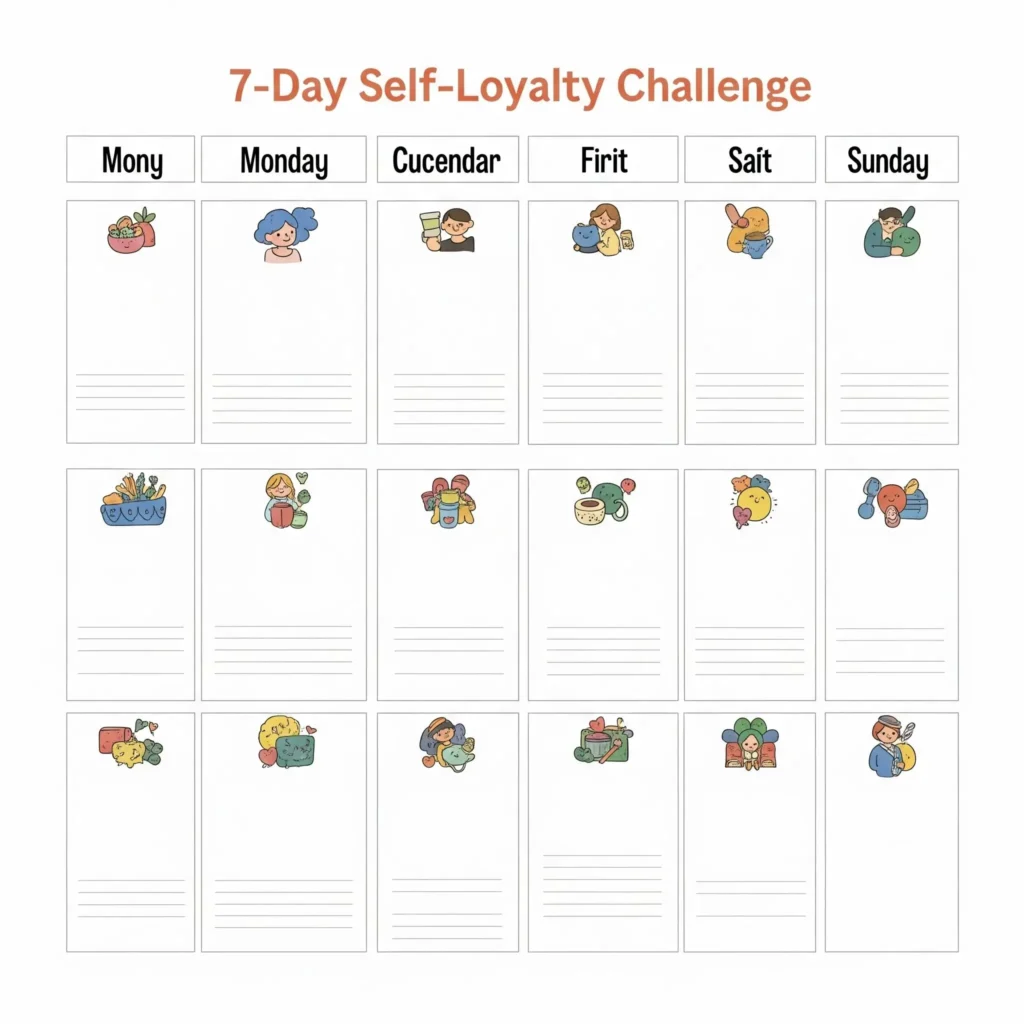
7-Day Self-Loyalty Challenge
Day 1: Identify one personal value and commit to honoring it all day.
Day 2: Politely say “no” to something that doesn’t align.
Day 3: Take 15 minutes to check in with your needs before making a decision.
Day 4: Write down 3 times you honored yourself this week.
Day 5: Share an honest opinion instead of agreeing to fit in.
Day 6: Do one activity purely for your own joy.
Day 7: Reflect on how these choices made you feel.
Rebuilding Self-Trust After Repeated Self-Abandonment
If you’ve been self-abandoning for years, rebuilding trust with yourself takes time, but it’s possible.
Acknowledge the Past Without Shame
Shame keeps you stuck. Instead of beating yourself up, recognize that you were doing the best you could with the tools you had.
Take Incremental Action
Don’t aim for perfection overnight. Choose one small act of loyalty daily, like speaking up in a meeting or taking a break when you’re tired.
Track Wins
Keep a self-loyalty journal where you record every instance of choosing yourself. Over time, you’ll see evidence that you can trust yourself again.
Tools & Resources for Practicing Self-Loyalty
Books: The Gifts of Imperfection by Brené Brown, Untamed by Glennon Doyle.
Therapy & coaching: a supportive environment to explore boundaries and values.
Guided meditations: apps like Insight Timer or Calm for emotional regulation.
Conclusion
Self-loyalty isn’t about shutting people out or refusing compromise; it’s about refusing to disappear in your own life. Every time you choose yourself, you strengthen the belief that you’re worth standing by.
Even in stress. Even in rejection. Especially then.
Remember: You are your longest commitment. Treat yourself like someone worth keeping.
FAQ: Self-Loyalty Practices & How to Not Self-Abandon
What are simple self-loyalty practices I can start today?
Identify one boundary you will uphold today.
Take 5 minutes before saying “yes” to anything.
How do I know if I’m self-abandoning?
If you consistently feel resentful, disconnected from yourself, or exhausted after interactions, it’s a sign.
Can self-loyalty harm relationships?
No. Healthy self-loyalty actually strengthens relationships because it’s rooted in honesty and respect.
How long does it take to rebuild self-trust?
There’s no set timeline, but small, consistent actions often lead to noticeable change within weeks.
Today, choose one self-loyalty practice from this article and commit to it for the next 24 hours. Watch how differently you feel when you stand by yourself, and let that be the start of a lifelong habit. ➤
You’ve dedicated your life to making others comfortable, anticipating needs, and agreeing even when exhausted. Yet, you still fear letting people down.
Have you ever wondered: When do I get to matter?
Setting boundaries may feel foreign and confrontational, but constant people-pleasing leaves you drained and disconnected from your own needs.
Here’s the truth: boundaries aren’t about rejecting others; they’re about accepting yourself.
Boundaries protect your time and energy, allowing you to live intentionally rather than out of obligation. They can even strengthen your relationships.
In this guide, you’ll learn to:
Recognize the emotional cost of saying “yes” too often.
Reframe boundaries as self-respect, not selfishness.
Communicate your needs kindly and directly, without guilt.
Handle pushback and guilt without abandoning yourself.
Maintain connection without overextending yourself.
You’re here to care without losing yourself, starting with one small shift: saying yes to you.
✅ Why People-Pleasers Struggle with Boundaries
You want to be liked, to keep the peace. You don’t want to seem difficult. That’s why, even when your schedule is packed or your energy is low, you still say yes. And while your intentions are kind, the results can quietly wear you down.
The Hidden Beliefs Behind People-Pleasing
It’s not just a habit, it’s a mindset. If you’re like many people-pleasers, your inner dialogue might sound like this:
“If I say no, they’ll think I don’t care.”
“My worth depends on how much I give.”
“I don’t want to disappoint anyone.”
These beliefs usually form early, sometimes in families where love was conditional or in environments where you were rewarded for being “easy” or agreeable. Over time, saying yes became your survival tool.
But it’s costing you.
What Constant Yeses Do to You
Without boundaries, you start to feel:
Emotionally exhausted: You give and give but rarely receive.
Disconnected from yourself: You struggle to name your needs, let alone meet them.
Resentful: You start to feel taken advantage of, even by people you care about.
Anxious or guilty: The fear of conflict or rejection eats away at your peace.
📌 Research insight: Studies on codependency and emotional burnout show that long-term people-pleasing increases stress, reduces life satisfaction, and can lead to depression or identity loss.
You don’t need to stop caring, you just need to care for yourself, too. And setting boundaries is how you begin doing that kindly, intentionally, and without guilt.
💡 The Mindset Shift: Boundaries as Emotional Self-Defense
If the idea of setting limits makes you feel guilty, you’re not alone. As a people-pleaser, you’ve probably been conditioned to believe that your value lies in being agreeable, helpful, and always available. But here’s a truth that changes everything:
Boundaries aren’t a form of rejection, they’re a form of emotional self-defense.
Boundaries Are Bridges, Not Walls
You may fear that boundaries will push people away or make you seem cold. But in reality, healthy boundaries do the opposite. They help you:
Stay emotionally safe without shutting people out.
Choose how much you give, instead of giving until you’re empty.
Build trust by showing others what’s okay and what’s not.
Boundaries aren’t barriers to love, they’re how you keep love sustainable.
Think of them as a filter that protects your energy and time, not a forcefield that keeps people out. You’re not cutting people off; you’re guiding them on how to connect with you in a way that works for both of you.
Why Emotional Self-Defense Matters
You’re allowed to protect your peace, even from people you care about. Emotional self-defense means:
Saying “I need space” when your mental bandwidth is gone.
Saying “no” when your plate is already full.
Saying “this doesn’t feel right” when something crosses your line.
These aren’t acts of defiance. They’re acts of self-respect. And without them, you risk:
Constant emotional depletion
Silent resentment that damages relationships
Losing sight of your own values, limits, and desires
You can’t keep pouring from an empty cup. Boundaries help you refill it, gently, firmly, and without apology.
Kindness and Assertiveness Can Coexist
It’s possible to be direct and respectful at the same time. You don’t have to raise your voice to be clear. You don’t have to be harsh to be firm.
Here’s how you can combine gentle language with firm intent:
“I’d love to help, but I need some time to recharge today.”
“I hear you, and I need to stick to my decision.”
“I care about our relationship, which is why I’m being honest about what I need.”
Compassion without boundaries is self-abandonment.
Let that sink in.
You’re not abandoning others by protecting yourself. You’re simply choosing balance, something every healthy relationship needs.
🧭 How to Start Setting Boundaries Kindly (Step-by-Step Guide)
Setting boundaries might feel foreign at first, especially if you’ve spent years putting others’ needs before your own. But with a few practical steps, you can begin to set limits that honor your well-being, without guilt and burning bridges.
Here’s your step-by-step guide to setting boundaries kindly, even if you’re new to it.
Step 1: Identify What’s Draining You
Before you set any limits, you need to know where your energy is going, and what’s leaving you feeling stretched too thin.
Ask yourself:
Which relationships leave me feeling exhausted instead of supported?
When do I say “yes” but wish I had said “no”?
Are there patterns where I give more than I receive?
💡 Pro tip:
Keep a “boundary journal” for one week. Write down every time you feel overwhelmed, resentful, or uncomfortable. Patterns will show you where boundaries are missing.
Step 2: Define What’s Okay (and What’s Not)
Once you recognize where your energy is leaking, it’s time to clarify your limits. Think of this as designing your emotional comfort zone.
Common boundary categories:
Time: You don’t have to be available 24/7.
Emotional energy: You’re not responsible for fixing everyone’s problems.
Personal space: You can ask for quiet time, privacy, or breaks from socializing.
Digital access: You’re allowed to unplug or not reply instantly.
Write down:
What behaviors drain you?
What actions feel disrespectful?
What are your non-negotiables?
Remember, this is about protecting your peace, not punishing others.
Step 3: Communicate Your Boundaries Clearly, and Kindly
Here’s where many people-pleasers hesitate. But expressing your needs doesn’t have to sound harsh. The key is to be direct, respectful, and firm.
Use “I” statements to focus on your feelings and limits, rather than blaming others.
✅ Helpful boundary phrases:
“I appreciate the invite, but I won’t be able to attend.”
“I’m working on saying no to avoid burnout, so I need to pass this time.”
“I’m happy to support you, but I can’t talk about this every day, it’s becoming too heavy for me.”
🗂️ Table: Sample Boundary Scripts by Situation
Situation
Example Boundary Phrase
A friend always needs last-minute help
“I’d love to support you, but I need more notice to make it work.”
A partner invades your alone time
“I recharge best alone. I’d like some solo time this evening.”
A coworker dumps their work on you
“I’m at capacity right now, so I can’t take this on.”
Family calls at inconvenient hours
“I’m not available at that time, but I can talk tomorrow.”
Step 4: Practice Saying No Without Over-Explaining
As a people-pleaser, you may feel the urge to give long justifications. But you don’t owe anyone a detailed explanation for your boundaries. A short, polite “no” is enough.
Less is more:
“I can’t make it, but thank you.”
“That’s not something I’m available for right now.”
Over-explaining often invites negotiation. Clear and kind is the way to go.
Step 5: Stay Consistent (Even When It’s Uncomfortable)
The first few times you say no or express a limit, it might feel awkward or even scary. You may worry that people will be upset or distance themselves.
But consistency builds trust, with others and with yourself.
Tips for staying firm:
Repeat your boundary without apologizing.
Don’t rush to fill silence after stating your needs.
Remind yourself: “My needs are valid, even if others don’t understand them.”
✅ Final Reminder
Setting boundaries kindly isn’t about saying no to everyone, it’s about saying yes to what truly supports your peace, energy, and growth.
You deserve to feel safe in your own life. And you have every right to protect your time, your space, and your emotional energy, without guilt.
💪 Dealing with Guilt and Pushback
When you first begin setting boundaries, guilt often comes rushing in. You might feel selfish, harsh, or like you’re letting people down. And sometimes, the people around you will push back, especially if they’ve gotten used to your constant yes.
But here’s the truth: guilt and resistance aren’t signs that you’re doing something wrong. They’re signs that you’re growing.
Why Guilt Shows Up When You Set Boundaries
As a people-pleaser, your self-worth may have been tied to your ability to make others happy. So the moment you stop accommodating everyone, your brain sounds the alarm.
You might think:
“They’ll think I don’t care.”
“I’m being too much or too distant.”
“They won’t understand why I need this.”
This discomfort is completely normal, especially if you were raised in a home, culture, or relationship where emotional self-sacrifice was expected.
But guilt doesn’t mean your boundary is wrong. It just means you’re stepping outside your old pattern.
The Pushback You Might Face (And How to Respond)
Unfortunately, not everyone will applaud your growth. Some may resist or even guilt-trip you. This doesn’t mean you need to retreat.
Common types of pushback:
Passive-aggressive comments: “You’ve changed.”
Emotional manipulation: “I guess I just don’t matter to you anymore.”
Overstepping again after you’ve said no: Ignoring your limit and acting like it was never set.
How to handle it:
Stay calm and grounded in your “why.”
Repeat your boundary if necessary. You don’t need to defend it.
Remind yourself: you’re not responsible for managing other people’s reactions.
Boundaries often reveal who respects your needs, and who only benefits from your lack of them.
What to Say to Yourself Instead of Believing the Guilt
When guilt starts creeping in, shift your self-talk to something more supportive and honest.
Try these affirmations:
“I am allowed to protect my energy.”
“Their disappointment is not my responsibility.”
“Kind people have boundaries, too.”
“Saying no to others is saying yes to myself.”
You can be caring and still say no. You can love people and still disappoint them. That’s part of being human, not a failure.
Building Emotional Resilience
Setting boundaries for the first time can feel like emotional whiplash. You might feel unsure, shaky, or even question yourself. That’s why it’s important to build inner resilience.
Here’s how:
Track your wins: Each time you honor a boundary, write it down.
Celebrate small victories: Even saying, “Let me think about it,” is a step toward change.
Surround yourself with support: Connect with people who respect your growth.
Every time you hold a boundary, you send yourself a powerful message: My needs matter. My voice matters. I matter.
Remember: Growth Often Feels Uncomfortable
The discomfort you’re feeling isn’t a red flag; it’s growing pains. You’re not being mean. You’re being clear.
Boundaries are not about control or punishment. They’re about preserving your well-being, so you can live a life that feels balanced and authentic.
Let people adjust. Let yourself adjust. And keep going.
🤝 Maintaining Relationships with Healthy Boundaries
One of the biggest fears you may have about setting boundaries is losing relationships. You care deeply, and the last thing you want is to come across as cold or distant. The truth is, healthy boundaries don’t push people away; they create stronger, more respectful connections.
When your relationships are based on honesty and mutual respect, not silent self-sacrifice, they become more sustainable and fulfilling for everyone involved.
Navigating Difficult Conversations with Kindness
You don’t have to choose between being kind and being honest. Both can exist in the same sentence.
When you’re ready to express a boundary, keep these guidelines in mind:
Use “I” statements: Focus on how you feel and what you need, not what the other person is doing wrong.
Be clear and specific: Avoid vague phrases like “I just need space,” and instead say, “I’d like to have an hour of alone time after work each day.”
Stay calm: If emotions rise, take a breath. Respond, don’t react.
Example phrases:
“I value our friendship, and I need to step back from daily calls so I can recharge.”
“I’m setting a new boundary around how often I check messages. It’s helping me focus and feel less overwhelmed.”
Tone matters. You’re not accusing, you’re informing. That shift in delivery can protect both your message and your relationship.
What to Expect as Relationships Adjust
Change often feels uncomfortable, not just for you, but for others too. When you begin setting healthier boundaries, some people may:
Be surprised or confused.
Push back at first.
Test your limits.
This doesn’t necessarily mean the relationship is doomed. It just means you’re resetting the dynamic. Stay patient and consistent; people who truly care will adapt.
Note: If someone continues to dismiss your boundaries, makes you feel guilty, or punishes you for expressing your needs, that’s a red flag. Respect should always go both ways.
When It’s Time to Reevaluate a Relationship
Not every connection will survive your healing, and that’s okay. Some relationships rely on you staying small, quiet, or endlessly available. When you stop overextending, it may reveal imbalances you hadn’t noticed before.
Signs a relationship may no longer serve your well-being:
Your boundaries are ignored or mocked.
You feel anxious before every interaction.
You constantly apologize for having needs.
Letting go isn’t failure, it’s freedom. You’re allowed to outgrow people who only valued your compliance.
Boundaries Build Real Connection
When you honor your own limits, you invite others to do the same. And that creates space for:
Mutual respect
Clear communication
Deeper trust
You stop guessing what others expect from you. You start showing up as your real self, no masks, no guilt.
That’s the version of you who builds strong, meaningful, and honest relationships.
📘 Conclusion: Your Permission to Choose Yourself
Setting boundaries isn’t rejection, it’s redirection toward self-respect and emotional clarity. It’s not about shutting others out. It’s about finally letting yourself in.
As a people-pleaser, you’ve spent years prioritizing peace outside of you. But now, it’s time to cultivate peace within you. Saying no isn’t harsh. It’s healing. It’s not an attack, it’s a kind declaration that you matter, too.
When you begin setting boundaries kindly, you create space for better energy, better relationships, and a better connection with your own needs. And you don’t need to get it perfect. You just need to start.
Let that one choice become your proof: you can set boundaries and still be kind.
❓ FAQ: Setting Boundaries Kindly for People-Pleasers
Q1: How do I set boundaries without hurting someone’s feelings?
A: Use kind, direct language that focuses on your needs rather than blaming the other person. For example: “I value our relationship, and I also need time to rest today.” Validating their feelings while still honoring your limit helps keep the tone compassionate.
Q2: What if someone gets angry when I set a boundary?
A: Their reaction belongs to them, not you. You’re not being unkind by expressing what you need. Stay calm, reaffirm your boundary, and avoid engaging in guilt or emotional manipulation. You’re allowed to protect your energy.
Q3: Is it selfish to prioritize my needs?
A: No. In fact, it’s essential. When you’re depleted, you can’t show up fully for yourself or anyone else. Prioritizing your well-being makes you more present, balanced, and authentic in your relationships.
Q4: What are some examples of emotional boundaries?
A: Emotional boundaries might include:
Saying no to emotionally heavy conversations you’re not ready for.
Refusing to tolerate passive-aggressive comments or guilt-tripping.
Choosing not to engage in arguments that leave you emotionally drained.
Limiting access to people who consistently disrespect your feelings.
By setting kind but firm boundaries, you’re not walking away from people, you’re walking toward your own self-trust, clarity, and inner calm.
Let this be your permission slip: you’re allowed to choose yourself. And when you do, the right people will meet you there, with respect. ➤
We are all communicators, and we do it daily, but communication is not always easy. Good communication means a lot, whether talking to your friends or colleagues or communicating when sharing ideas. The thrilling part is that nowadays, artificial intelligence- or AI- is coming to our rescue as it tries to assist us in enhancing these competencies. Not only are AI tools useful in providing us with prompt feedback, but they are also useful in coaching us on how to conduct a conversation. In this article, we will look into how AI can assist you and help you improve your communication skills in simple and practical ways.
The Relevance of Communication Skills
Good communication is the main part of strong relationships and the communication of your ideas. This can be different when conversing with your friends, working with colleagues, or addressing a crowd. However, this is not always simple; we can not always come up with the right words, listen, and comprehend people. Such issues may arise from miscommunication or lower self-confidence.
This is why it is crucial to enhance communication skills. It makes it easier to interact with other people, find solutions, and even be more comfortable with ourselves. The best part is that, due to AI, learning and practicing such skills has never been easier or more available.
The Support to Communication Skills Done Using AI
Artificial intelligence is rapidly becoming an auxiliary resource to everyone who wants to enhance the quality of interactions. Many apps and programs that exist today provide you with feedback, practice, and coaching based on your needs and run on AI. For example, certain AI devices can listen to what you say and recommend how you can articulate or present yourself more appealingly. Other people may assist in writing by correcting the grammar, giving you different words that sound better, or making your tone of voice friendlier and captivate the attention.
A well-known AI communication coach, Poised, gives real-time feedback throughout a call and a presentation, allowing you to change your speaking manner. Writing tools such as Grammarly will analyze your messages or emails, correct mistakes, and advise you on areas to improve so that you can be able to write better and with ease. Of course, there are AI tools that will assist you with public speaking as they will mimic a real conversation and provide you with advice on pace, tone, and body language.
In addition to error correction activities, AI makes you more conscious of your communication style. It is also able to highlight such practices as filler word usage or talking too quickly, which you may not realize. Such individually carved feedback is tantamount to having a coach on call at any time of the day, and therefore, it will be needed less to practice and stage better with time.
In a word, AI-based tools are transforming communication practice to be more interactive, supportive, and less generic, helping people become better at it in a way that supports their busy lives.
How to Use AI to Improve Communication Practically
You can effortlessly develop communication using AI. Numerous aids are available to assist you in practicing, receiving feedback, and gaining confidence in various spheres of communication.
AI-powered apps that can train you to have conversations in a relaxed, pressure-free setting are examples of how that is possible. You can talk with virtual assistants or chatbots that recreate real-life interactions, in which you can test out various phrases and see immediate feedback on your progress. This is particularly useful when you wish to enhance your speech or get acquainted with a new language.
Another field in which AI excels is writing. Instruments such as Grammarly or Hemingway help you check spelling errors. Still, they also help you make your writing clearer, friendlier, or more professional, according to your aim. Whether writing an email, a report, or even a post on social media, these AI assistants can help you improve your communication.
If you struggle with public speaking, certain AI applications will provide you with a speaker rating based on your tonality, speaking speed, or audibility. They can even determine your body language and offer you some advice on how to improve it, making you a more confident and interesting speaker.
In addition to personal capacities, AI may help resolve conflicts by giving objective opinions and seeking ground. It can also study your communication patterns to improve your emotional intelligence, which makes emotions easier to comprehend and control in conversations.
Altogether, AI technology presents convenient, individual, practical means of practicing communication and mastering it. You can practice it in any place or time and make it a part of your everyday life.
The advantages of AI-based communication training The benefits of using AI-based communication training
There are many advantages of using AI to improve your communication skills. First, AI will provide you with detailed feedback in real-time.Instead of waiting for someone to find time to edit your work or even listen to your speech, AI-enhanced software can identify flaws in real-time. This keeps you motivated and facilitates a better learning process.
The ease of access is another great advantage. AI coaches and applications can be accessed at any time and place: at home, at work, or on the move. This also implies that you can practice during your spare time, so when you only have a few minutes, you can use that time to train your skills.
AI also customizes its feedback on how you write and your requirements. It does not provide general tips but evolves according to your weaknesses and strengths, making your learning relevant and efficient.
Besides, AI tools can assist you in becoming more self-aware. They bring out behaviors that you are not aware of, such as talking too fast or using ambiguous language. Becoming acquainted with those patterns is important as the first step towards serious change.
Lastly, AI-powered training tends to be non-threatening compared to practicing with others. You are allowed to test, err, and learn without any judgment. This instills confidence and automatically enhances communication in real-life scenarios.
Simply put, AI will make communication training more convenient, personal, and encouraging so that you can build and develop your skills gradually but confidently.
Restrictions and Cavesat
Although there is exciting potential to improve our communication skills with the help of AI, it is critical to keep in mind its possibilities and limitations. I think AI is a very strong tool, but it cannot replace the actual connection with human beings. Communication is a very human thing, and it involves emotions, common experiences, and little clues that may not well be understood by AI.
An AI can inform you that your voice is nervous, but it cannot experience that complex feeling that made your voice sound that way, or it cannot even communicate empathy to you that a human friend or therapist would be able to. In equal measure, though, the AI may be able to guide you on how to write a clear email, but it will not know the office politics, the history between the two of you, and the person you are addressing as a human being would.
The next thing to remember is that the overuse of AI may cause us to lose faith in our natural communication skills if we do not train them in real life. The aim of AI use should be to enrich our abilities, not diminish the necessity of direct human contact.
It is a question of striking a balance. Obtain feedback, train in an unrestricted environment, and develop new skills with the help of AI. However, never forget that you must use what you have learned in life in actual communication in the real world to develop real relationships and to experience the dirty, fabulous life of human communication firsthand. AI is an amazing helper, yet the secret of effective communication remains human perceptions and empathy.
Future Outlook
In the future, AI will transform communication more than ever. By 2025 and beyond, AI will not only assist with simple feedback or training experiences; rather, it will develop a very customized communication experience that is specific and unique to the individual. For example, AI will create tailor-made content, guess what you will say next, and even assist you in having a better connection in virtual or distant environments such as virtual reality.
Artificial intelligence is already being used in business to ensure that customer interaction is streamlined and personal, and this is spreading to the ordinary person. Tools powered by artificial intelligence will also get smarter and more aware of emotions and contexts, assisting us in communicating more emphatically and effectively.
Meanwhile, emerging technologies such as quantum encryption and blockchain will make digital communication more secure and trustworthy, and our privacy will remain intact as AI-driven platforms gain greater prominence.
Human creativity and AI’s ability to personalize, analyze, and assist us will become dominant in the communication field to improve communication. With these tools on board, we should be in a better place to not just phrase out our messages more explicitly but also to better touch other people.
Concisely, AI is no longer only a means of more efficient communication nowadays; it is also creating a future in which communication will be more natural, efficient, and meaningful to all of us.
Conclusion
The process of learning and practicing communication skills is becoming more comfortable and more individual with the help of AI, which is changing the realm of education. It cannot compete with the natural human connection and empathy. However, AI has still provided us with important assistance due to its ability to provide feedback in real-time, allow us to train safely in a non-hazardous environment, and provide us with advice that suits our personalities. AI is still evolving and will become an even more effective friend in assisting us in establishing an effective communication channel with a clear vision of self-assurance and potential value to others.
With a conscious approach to using AI tools and balancing actual practice, we have the chance to open up new horizons of communication, allowing us to have better relationships, careers, and personal development. Human empathy and AI’s smart support are creating a new future of communication, which has many perspectives to open before all those who are ready to evolve and improve. ↗
Being empathetic means sharing and understanding what other people experience in their feelings. Development of empathy becomes essential now because our society often displays divisions. Empathy adds value to our personal lives along with professional relationships while growing connections between people and improving mutual understanding. The following article delivers real-world tactics to build empathetic behaviors for frequent interpersonal exchanges.
Understanding Empathy
Different Types of Empathy
Empathy can be broadly categorized into two main types: affective empathy and cognitive empathy.
Affective Empathy: This involves physically feeling another person’s emotions, almost as if they are your own. It allows you to resonate with others’ feelings, creating a deep emotional connection. For example, when a friend shares their sadness, you might feel a wave of sorrow yourself, prompting you to offer support.
Cognitive Empathy: This type focuses on understanding another person’s perspective or mental state without necessarily feeling their emotions. It’s about grasping what someone else is thinking or experiencing. Cognitive empathy enables you to recognize why someone might react a certain way, facilitating communication and problem-solving.
Benefits of Being Empathetic
Being empathetic offers numerous advantages, including:
Improved Relationships: Empathy fosters trust and mutual respect, leading to stronger personal and professional relationships. When people feel understood, they are more likely to open up and connect.
Enhanced Communication: Understanding others’ feelings can lead to more meaningful conversations. Empathetic communication encourages honesty and openness, reducing misunderstandings.
Greater Emotional Intelligence: Empathetic individuals often exhibit higher emotional awareness. This ability to recognize and understand emotions, both in themselves and others, helps navigate social situations more effectively.
Practical Tips for Cultivating Empathy
Active Listening
Active listening is a cornerstone of empathy. It requires full engagement in the conversation. Techniques for effective active listening include:
Maintaining Eye Contact: This shows the speaker that you are focused and interested in what they’re saying.
Nodding and Using Verbal Acknowledgments: Simple affirmations like “I see” or “That sounds challenging” encourage the speaker to continue sharing their thoughts.
Avoiding Interruptions: Allow the speaker to express themselves completely before offering your thoughts. This demonstrates respect and consideration for their feelings.
Putting Yourself in Others’ Shoes
Practicing perspective-taking can deepen your understanding of others. Here are some ways to do this:
Engaging in Role-Playing: Imagine how you would feel in another person’s situation. This can help you appreciate their emotions and reactions.
Exploring Diverse Backgrounds: Learn about different cultures and experiences. Reading books, watching films, or attending cultural events can broaden your understanding and foster empathy toward those from different walks of life.
Asking Open-Ended Questions
Encouraging deeper conversations helps build connections. Use open-ended questions that invite elaboration, such as:
“How did that experience make you feel?”
“What do you think about this situation?”
These questions allow others to share their thoughts and emotions more freely, fostering a richer dialogue.
Practicing Mindfulness
Mindfulness enhances your ability to empathize by increasing awareness of your own emotions and those of others. Try these simple exercises:
Daily practice of meditation includes monitoring your breathing while observing thoughts in a non-judgmental manner for several minutes per session. Meditation enables people to develop their sensitivity toward emotions.
Body Scanning: Pay attention to physical sensations in your body and how they relate to your emotions. This exercise can deepen your connection to your emotional state and enhance your empathic responses.
Reflecting on Your Feelings
Taking time to understand your emotions can improve your empathetic interactions. Consider these approaches:
Journaling: Write about your daily interactions and your emotional responses to them. Reflection on your inner emotions enables you to identify recurring patterns together with triggering circumstances.
Recognizing Triggers: Identify situations that evoke strong emotions. Understanding why these triggers affect you can enhance your ability to empathize with others experiencing similar feelings.
Empathy in Different Contexts
In Personal Relationships
Empathy is essential for nurturing personal relationships. It helps build trust and understanding, allowing friends and family members to feel valued and heard. By practicing empathy, you can navigate conflicts more effectively and foster deeper connections. When you take the time to understand your loved ones’ feelings, it strengthens your bond and creates a supportive environment where everyone feels safe to express themselves.
In the Workplace
Empathy in the workplace contributes to a positive culture and enhances teamwork. When colleagues demonstrate empathy, they are more likely to support one another, leading to increased collaboration and productivity. Empathetic leaders can inspire their teams, creating an atmosphere of trust that encourages open communication. By understanding the challenges and emotions of coworkers, you can foster a more inclusive and supportive work environment, ultimately improving morale and job satisfaction.
In Community Engagement
Engaging with your community through volunteer work or local events can significantly expand your empathetic understanding. By interacting with diverse groups of people, you gain insights into their experiences and challenges. This exposure not only broadens your perspective but also fosters a sense of connection and responsibility toward others. Empathy in community engagement encourages social cohesion and helps address societal issues by promoting understanding and collaboration among different groups.
Overcoming Barriers to Empathy
Addressing Biases and Stereotypes
One of the primary barriers to empathy is our inherent biases and stereotypes. These preconceived notions can cloud our judgment and prevent us from fully understanding others. To overcome this, it’s essential to actively challenge your assumptions. Educate yourself about different cultures, experiences, and perspectives. Engaging with diverse communities and listening to their stories can help dismantle stereotypes and foster a deeper appreciation for others’ experiences.
Managing Emotional Fatigue
Empathy can sometimes lead to emotional fatigue, especially when we are exposed to others’ struggles repeatedly. It’s important to practice self-care to maintain your emotional well-being. Set healthy boundaries to protect your own mental health while still being supportive to others. Taking breaks, engaging in activities that replenish your energy, and seeking support when needed can help you manage emotional fatigue and stay empathetic without feeling overwhelmed.
Strategies for Staying Empathetic in Challenging Situations
In difficult or high-stress situations, it can be challenging to respond with empathy. To navigate these moments, take a step back and breathe. Remind yourself of the importance of empathy and the value of understanding the other person’s perspective. Practice mindfulness techniques to center yourself, allowing you to approach the situation with a clearer mind. By consciously choosing empathy, even when it’s tough, you can foster a more constructive dialogue and strengthen your connections.
Conclusion
Developing compassion is fundamental for building important associations and cultivating understanding in our progressively isolated world. By practicing the tips sketched out over, you’ll create compassionate propensities that improve your intuitiveness and advance a more compassionate environment. Begin nowadays by taking little steps towards a more sympathetic life.
Forgiveness is the conscious decision to let go of resentment and thoughts of revenge toward those who have wronged us. It’s a powerful act that goes beyond a mere apology or reconciliation; it is an essential step toward emotional healing and personal freedom.
Practicing forgiveness allows individuals to release the emotional burdens of anger and bitterness, which can otherwise weigh heavily on their mental and emotional well-being. By forgiving, you reclaim your peace and empower yourself to live a more fulfilling life.
Understanding Forgiveness
The Nature of Forgiveness
Forgiveness is a multifaceted process that involves both emotional and cognitive components. It is not merely about saying “I forgive you”; it entails a deep emotional journey that requires you to confront the hurt caused by someone else’s actions. Forgiveness allows you to acknowledge the pain without letting it define your life or your future. It is about making a conscious choice to release the grip that past grievances have on you, thus freeing yourself from the emotional burdens that can weigh heavily on your mental well-being.
The essence of forgiveness provides individuals with self-liberation. When you forgive, you are not excusing the behavior of the person who wronged you; rather, you are choosing to let go of the anger and resentment that can consume you. This act can lead to a transformation in your emotional landscape, allowing more space for positive experiences and emotions. The practice of forgiveness develops mental strength which becomes a significant factor in emotional resilience.
Common Misconceptions about Forgiveness
Myth 1: Forgiveness is Weakness Many individuals mistake forgiveness for weak behavior as they believe it means accepting immoral conduct. Real forgiveness demands extraordinary strength and courage from human beings. The process requires you to confront your pain directly before consciously choosing to advance of it. This act of bravery is a testament to one’s emotional fortitude and commitment to personal growth.
Myth 2: Forgiveness Requires Reconciliation People often believe they have to reconcile with their enemies but forgiveness does not require any type of connection between them. Although reconciliation has value in some cases it remains optional. People who forgive retain the power to grant amnesty to another person although they choose to avoid interacting with the individual. The ability to control your own wellbeing provides protection for your values and safety by controlling former dangerous associations.
Myth 3: Forgiving Means Forgetting Some believe that forgiving someone means you must forget the offense entirely. This notion can lead to confusion, as it implies that forgiveness erases the past. In reality, forgiveness allows you to acknowledge the hurt while choosing not to let it dictate your present or future. It involves integrating the experience into your life story without allowing it to overshadow your journey. This distinction is crucial for emotional healing, as it empowers you to learn from the experience rather than be defined by it.
The Benefits of Forgiveness
Emotional Relief
One of the most significant benefits of forgiveness is the emotional relief it provides. Holding onto anger and resentment can create a heavy emotional burden that affects your mental health. When you choose to forgive, you actively release those negative emotions, leading to a profound sense of relief. This emotional release can reduce feelings of anxiety and depression, allowing for an improved mood and overall sense of well-being. The practice of forgiveness leads people to experience a weightless sensation and feelings of serenity, according to research evidence. This newfound emotional freedom enables you to focus on positive experiences and relationships rather than being trapped in a cycle of hurt and negativity.
Improved Relationships
Forgiveness can significantly enhance your relationships, both with yourself and others. When you practice forgiveness, you cultivate a sense of empathy and understanding that fosters deeper connections. It allows you to move past grievances and misunderstandings, paving the way for healthier and more meaningful interactions. By letting go of resentment, you create space for compassion and open communication, which are essential for nurturing strong relationships. Moreover, forgiving someone can also inspire them to reflect on their actions and possibly change their behavior, leading to a more positive dynamic in the relationship. In essence, forgiveness acts as a bridge that can mend rifts and strengthen bonds.
Better Physical Health
The impact of forgiveness extends beyond emotional well-being; it also has tangible benefits for physical health. Research has demonstrated a strong connection between emotional states and physical health outcomes. Individuals who practice forgiveness often experience lower blood pressure, reduced heart disease risk, and improved immune function. When you hold onto anger and resentment, your body remains in a state of heightened stress, which can lead to various health issues over time. Conversely, by embracing forgiveness, you can lower stress levels and promote relaxation, contributing to better overall health. This mind-body connection highlights the importance of emotional healing as a crucial aspect of physical wellness.
Increased Resilience
Forgiveness plays a vital role in building resilience, allowing you to bounce back from adversity with greater strength and adaptability. When you learn to forgive, you develop a mindset that empowers you to confront challenges without being weighed down by past grievances. This ability to let go of negative emotions equips you with the tools to navigate future difficulties more effectively. Resilience is not just about enduring hardships; it also involves learning and growing from them. By practicing forgiveness, you cultivate a positive outlook that fosters personal growth, enabling you to face life’s challenges with confidence and grace. In this way, forgiveness becomes a foundational element in your journey toward emotional and psychological resilience.
The advantages of forgiveness produce major consequences across various aspects including emotions and relationships as well as physical well-being and psychological state. Embracing forgiveness opens the door to a healthier, more fulfilling existence, allowing you to move beyond past hurts and live with greater joy and purpose.
Steps to Practicing Forgiveness
Acknowledge Your Feelings
To initiate the path of forgiveness, you first need to understand your emotions. It is essential to recognize and accept the hurt, anger, and disappointment you may be experiencing. These emotions are valid and deserve your attention. By allowing yourself to feel these emotions without judgment, you create a safe space for healing.
One effective way to process your feelings is through journaling. Writing about your experiences can provide clarity and help articulate what you’re feeling and why it matters. You might also consider expressing your emotions through creative outlets like art or music, which can serve as powerful tools for emotional release. Acknowledging your feelings is not about wallowing in negativity; rather, it is a crucial first step in understanding the depth of your hurt and the impact it has on your life.
Reflect on the Situation
Once you have acknowledged your feelings, take time to reflect on the situation that caused you pain. This step involves examining the context of the offense and considering the motivations behind the other person’s actions. Reflection is not about justifying their behavior but seeking to understand it.
Ask yourself questions such as: What might have led them to act this way? Were there external factors influencing their behavior? This process of reflection can foster empathy, allowing you to see the incident from a broader perspective. Understanding the other person’s background, challenges, or insecurities can soften your heart and make it easier to move toward forgiveness.
Make a Conscious Choice to Forgive
Forgiveness is ultimately a conscious choice. It involves making a deliberate decision to let go of the hurt and resentment that may be holding you back. This choice may not come easily, and it may require time and introspection. However, committing to the process is crucial for your healing.
To solidify this decision, you might consider verbalizing your intent. Saying aloud, “I choose to forgive [Name] for [specific action],” can be a powerful affirmation. This declaration serves as a commitment to yourself and your well-being. Keep in mind that this is a journey, and it’s okay to revisit this choice as you work through your emotions.
Practice Empathy
Empathy is a vital component of forgiveness. Simulating the other person’s shoes requires your effort to comprehend how they view situations. While this does not excuse their actions, it can help you see the situation from their viewpoint, which may lead to a more compassionate response.
To cultivate empathy, consider engaging in active listening if the opportunity arises. One should dedicate their whole attention to the words of the other person while they talk instead of getting ready to respond. You can also visualize the individual’s struggles and challenges, acknowledging that everyone has their battles. Practicing empathy can transform your feelings of anger into understanding, further paving the way for forgiveness.
Let Go of Expectations
As you move forward in your forgiveness journey, it’s essential to let go of any expectations regarding how the other person should respond to your forgiveness. Many people tie their ability to forgive to the hope of receiving an apology or acknowledgment from the offender. However, this can hinder your healing process.
Recognize that forgiveness is primarily about your healing and well-being, not about changing the other person. Release the notion that they need to behave in a certain way for your forgiveness to be valid. By letting go of these expectations, you free yourself from additional pain and disappointment, allowing your forgiveness to flourish in its own right.
Seek Support
Forgiveness can be a challenging and emotional journey, and seeking support can make a significant difference. Sharing your feelings with trusted friends or family members can provide valuable insights and reassurance. They can offer different perspectives or simply lend a listening ear, which can help you process your emotions more effectively.
If needed, consider reaching out to a therapist or counselor who specializes in emotional healing and forgiveness. Professional guidance can provide you with tools and strategies to navigate your feelings and foster a deeper understanding of the forgiveness process. Surrounding yourself with supportive people can reinforce your commitment to forgive and help you stay accountable on your healing journey.
Engage in Forgiveness Rituals
Engaging in forgiveness rituals can serve as a symbolic act that reinforces your intent to forgive. These rites can hold diverse forms because individuals follow their own beliefs and preferred customs.
One common ritual is writing a letter to the person who hurt you, expressing your feelings and the impact of their actions on your life. You can choose to send the letter or keep it as a personal reflection. To mark the decision of disposing resentment a small ritual such as candle-lighting or performing meditation can be established.
These rituals can help solidify your commitment to forgiveness and provide a tangible way to mark the transition from hurt to healing. They serve as reminders that forgiveness is a process and that you are actively choosing to release the past.
Moving Forward
The Continuous Journey of Forgiveness
Forgiveness is not a one-time event; rather, it is a continuous journey that requires ongoing reflection and commitment. As you navigate this path, you may find that forgiveness is not linear; there will be ups and downs. Some days you may feel strong and resolute in your decision to forgive, while other days you might struggle with lingering resentment or pain. This ebb and flow is a natural part of the healing process.
It’s important to recognize that forgiveness can take time, and it often requires revisiting your feelings and thoughts about the situation. As you grow and change, your perspective on the offense may also evolve. There may be moments when you feel the weight of the past hurts more acutely, and that’s okay. Allow yourself the grace to experience these feelings without judgment. Embracing this continuous journey means acknowledging that healing is not a destination but rather an ongoing process of self-discovery and emotional growth.
To support your journey, consider creating a forgiveness practice that you can return to regularly. This could involve setting aside time for self-reflection, journaling about your progress, or engaging in mindfulness exercises that focus on compassion and letting go. By making forgiveness a regular part of your life, you reinforce your commitment to emotional freedom and well-being.
Patience and Self-Compassion in the Process
As you move forward in your forgiveness journey, it’s essential to cultivate patience and self-compassion. Healing from emotional wounds takes time, and rushing the process can lead to frustration and setbacks. Recognize that everyone’s journey is unique, and it’s okay to take the time you need to fully process your feelings.
The same caring attitude used when supporting friends should be directed toward yourself as part of being self-compassionate. When you experience setbacks or find it difficult to forgive, practice self-compassion by acknowledging your struggles without harsh judgment. Remind yourself that it’s normal to have complex emotions and that healing is not always a smooth path.
You might also consider affirmations or mantras that reinforce your commitment to self-compassion. Phrases like “I am worthy of peace” or “I choose to heal at my own pace” can serve as powerful reminders that your journey is valid and deserving of respect. By fostering a compassionate relationship with yourself, you create a supportive environment in which forgiveness can flourish.
Embracing New Beginnings
Moving forward also means embracing new beginnings. Once you have taken steps toward forgiveness, you may find that you are more open to new experiences and relationships. Letting go of past grievances can create space for positive connections and opportunities in your life.
Consider how forgiveness can transform your outlook on future relationships. By freeing yourself from the emotional baggage of past hurts, you can approach new interactions with a fresh perspective. People who share their feelings with others develop stronger connections which become marked by empathy and trust as well as mutual respect.
Moreover, forgiveness can empower you to set healthy boundaries in your relationships moving forward. By understanding your emotional needs and recognizing the importance of self-care, you can create a more balanced dynamic in your interactions. This proactive approach not only protects your emotional well-being but also fosters a sense of agency in your life.
The Transformative Power of Forgiveness
Ultimately, moving forward after practicing forgiveness is about embracing the transformative power it holds. Forgiveness can lead to profound changes in how you view yourself and the world around you. It allows you to release the past and step into a future filled with possibilities.
As you continue on this path, take time to celebrate your progress and acknowledge the strength it takes to forgive. Each step you take toward forgiveness is a step toward reclaiming your emotional freedom and well-being. By embracing the journey, practicing self-compassion, and remaining open to new beginnings, you can unlock the full potential of forgiveness and its ability to enrich your life.
Conclusion
Forgiveness is a powerful tool for personal freedom. By letting go of resentment and embracing empathy, you can release yourself from emotional chains and cultivate a more joyful and peaceful life.
Remember, forgiveness is not for the other person; it is a gift you give to yourself. Embrace the journey of forgiveness, and discover the liberation it can bring to your life. By choosing to forgive, you open the door to a brighter, more fulfilling future.
Limits are the invisible lines we draw around ourselves to protect our physical, emotional, and mental well-being. They define what we are comfortable with and how we expect to be treated by others. In relationships, these limits are essential for fostering mutual respect, trust, and understanding. Yet, many people struggle with setting and maintaining them, often fearing conflict, rejection, or being perceived as selfish. This article explores the art of establishing clear limits, their significance in relationships, and how to communicate them effectively to build healthier, more fulfilling connections.
The Significance of Establishing Healthy Boundaries
Limits are the foundation of any healthy relationship. They act as a guide for how we interact with others and how we allow others to engage with us. Without these limits, relationships can become chaotic, one-sided, or even toxic. Here are some key reasons why setting clear limits is crucial:
Establishing limits is an act of self-respect. It signals to yourself and others that your needs, feelings, and well-being matter. By prioritizing self-care through these limits, you create a healthier relationship with yourself, which in turn improves your connections with others.
Enhances Mutual Respect
Healthy limits foster mutual respect in relationships. When you clearly communicate your guidelines, you encourage others to do the same. This creates a balanced dynamic where both parties feel valued and understood.
Reduces Stress and Emotional Burnout
Without established limits, it’s easy to become overwhelmed by the demands and expectations of others. Setting guidelines helps you manage your energy and time, reducing stress and preventing emotional burnout.
Fosters Healthier Communication and Trust
Boundaries encourage open and honest communication. When you express your needs and limits clearly, it builds trust and deepens your connection with others.
On the other hand, failing to set boundaries can lead to resentment, frustration, and a loss of individuality. It can also result in increased conflict and misunderstandings, as others may unintentionally overstep your limits.
Types of Boundaries in Relationships
Why Understanding These Types Matters
Recognizing the different types of boundaries allows you to address specific areas where you may feel uncomfortable or disrespected. By establishing clear guidelines in each category, you create a balanced and respectful dynamic in your relationships. Whether it’s protecting your emotional space, managing your time, or setting financial guidelines, these principles are key to fostering healthier and more fulfilling connections.
Emotional
Emotional boundaries protect your feelings and emotional well-being. They involve being mindful of how much emotional energy you invest in others and ensuring that others respect your emotional space. Examples include:
You should determine the boundaries of your emotional support offering
Not allowing others to dismiss or invalidate your feelings.
Avoiding oversharing personal information with people who may misuse it.
Physical
Physical boundaries relate to your personal space and touch. They define what kind of physical contact you are comfortable with and how close others can get to you. Examples include:
Respecting others’ physical boundaries in return.
Deciding who can hug you, touch you, or enter your personal space.
Setting limits on physical intimacy in romantic relationships.
Time
Time boundaries involve managing your time and energy effectively. They help you balance your commitments and ensure that you have enough time for yourself. Examples include:
Prioritizing self-care and downtime without feeling guilty.
Saying no to requests that interfere with your personal time.
You need to determine the duration of interactions with particular individuals.
Digital
In today’s digital age, boundaries around technology are essential. These boundaries help you manage your online interactions and protect your mental health. Examples include:
Avoiding oversharing personal information online.
Limiting screen time and social media use.
Setting rules for texting or calling, such as not responding to messages after a certain hour.
Financial
Financial boundaries are important in relationships where money is involved. They help you manage shared expenses and avoid financial stress. Examples include:
Avoiding lending money to friends or family if it makes you uncomfortable.
Setting limits on how much you’re willing to spend on gifts or outings.
Being clear about financial responsibilities in shared living arrangements.
How to Identify Your Boundaries
Before establishing boundaries you need to determine what exactly these boundaries should be. You need to process your values together with identifying your needs and limitations before creating boundaries. Multiple steps exist to help you establish your boundaries:
Reflect on Your Values and Needs
Your boundaries are rooted in your core values and personal needs. Devote your thoughts to the things which truly matter to you. Ask yourself:
What do I value in relationships (e.g., respect, honesty, independence)?
What makes me feel safe, respected, and appreciated?
What are my non-negotiables in relationships?
By understanding your values, you can identify the boundaries that align with them.
Recognize Signs of Discomfort or Resentment
Think about recurring situations where you’ve felt uneasy or unhappy. These patterns often reveal where your boundaries are being violated. For example:
Do you often feel pressured to say yes when you want to say no?
Are there people who consistently overstep your limits?
Do you feel overwhelmed by others’ demands on your time or energy?
Identifying these patterns can help you establish boundaries to prevent future discomfort.
Understand Your Limits
Boundaries are about knowing your limits and honoring them. Ask yourself:
How much time, energy, or emotional support can I realistically give to others?
What behaviors or actions am I unwilling to tolerate?
What do I need to feel balanced and fulfilled in my relationships?
Being honest with yourself about your limits is crucial for setting effective boundaries.
Communicating Boundaries Effectively
Once you’ve identified your boundaries, the next step is to communicate them clearly and effectively. Here are some tips for doing so:
Be Clear and Specific
Vague boundaries can confuse others and make it harder for them to respect your limits. A direct presentation should include your needs as well as their essential function. For example:
You should express your need for post-work relaxation by asking for an hour of personal time instead of requesting space.
Instead of saying, “Don’t be so demanding,” say, “I can only take on two projects this week.”
Specificity leaves no room for misinterpretation.
Use “I” Statements
The usage of “I” statements lets you express your emotions while remaining free from accusations or judgments directed at others. They focus on your experience rather than the other person’s behavior. For example:
When expressing yourself instead of stating that someone doesn’t listen to you it would be better to express “I feel unheard when others interrupt me.”
Instead of saying, “You’re always late,” say, “I feel disrespected when plans are delayed without notice.”
This approach reduces defensiveness and encourages open dialogue.
Choose the Right Time and Place
TTiming and setting play a significant role in how your limits are received. Avoid discussing them in the heat of an argument or when emotions are running high. Instead:
Choose a calm, private setting where both parties can focus.
Pick a time when neither of you is stressed or distracted.
Ensure the other person is in a receptive mood.
A thoughtful approach increases the likelihood of a positive outcome.e response.
Stay Calm and Assertive
Assertiveness is key to communicating boundaries effectively. It involves expressing your needs confidently without being aggressive or passive. Tips for staying assertive include:
Dual eye contact with a consistent vocal tone should be kept during the communication session.
Avoid apologizing for your boundaries (e.g., “I’m sorry, but…”).
Stand firm in your decision, even if the other person reacts negatively.
Remember, boundaries are about self-respect, not control.
Be Prepared for Pushback
Not everyone will respond positively to your boundaries, especially if they’re used to crossing them. Be prepared for resistance and stay calm. If the other person reacts negatively:
Reiterate your boundary calmly and firmly.
Avoid engaging in arguments or justifying your needs excessively.
Remind yourself that their reaction is not a reflection of your worth.
Boundaries are about protecting your well-being, not pleasing others.
Maintaining and Respecting Boundaries
Setting boundaries is only the first step; maintaining and respecting them is equally important. Here’s how to do it:
Be Consistent
Consistency is key to enforcing boundaries. If you allow others to cross your limits occasionally, they may not take your boundaries seriously.
Revisit and Adjust Boundaries as Needed
Boundaries are not set in stone. As relationships evolve, your boundaries may need to be adjusted. Regularly check in with yourself and your partner to ensure your boundaries are still relevant.
Respect Others’ Boundaries
Just as you expect others to respect your boundaries, it’s important to respect theirs. This creates a reciprocal dynamic of mutual respect and understanding.
Address Boundary Violations
If someone crosses your boundaries, address the issue promptly. Calmly explain how their actions affected you and reiterate your limits.
Common Challenges in Setting Boundaries
Setting boundaries can be challenging, especially if you’re not used to doing so. The following list presents usual challenges along with procedures for their resolution:
Fear of Rejection or Conflict Most individuals refrain from establishing boundaries since they dread facing rejection and emerging conflicts. Remember that healthy relationships require honesty and respect. If someone reacts negatively to your boundaries, it may be a sign that the relationship needs reevaluation.
Guilt or People-Pleasing Tendencies People-pleasers often struggle with setting boundaries because they prioritize others’ needs over their own. You should practice self-compassion because boundary setting stands as a practice of self-care rather than being selfish.
Cultural or Societal Expectations Cultural or societal norms may discourage boundary-setting, especially in close-knit communities. It’s important to prioritize your well-being, even if it goes against societal expectations.
Fear of Being Perceived as Selfish Setting boundaries is not selfish; it’s necessary for maintaining healthy relationships. By taking care of yourself, you’re better equipped to show up for others.
Practical Tips for Setting Boundaries in Different Relationships
Boundaries look different depending on the type of relationship. Here are some practical tips for setting boundaries in various contexts:
Romantic Relationships
Communicate your needs and expectations early on.
Establish limits around personal space, time, and communication.
Be honest about your deal-breakers.
Family Relationships
Set guidelines around family obligations and expectations.
Limit interactions with toxic family members.
Be clear about your financial and emotional limits.
Friendships
Determine how often you socialize.
Be open about what you can and cannot do for your friends.
Avoid friendships that drain your energy.
Workplace Relationships
Avoid taking on more than you can handle.
Define your work hours and availability.
Communicate your limits to colleagues and supervisors.
Conclusion
The art of establishing guidelines is a skill that requires practice, self-awareness, and courage. By setting healthy boundaries, you protect your well-being, foster mutual respect, and build stronger, more fulfilling relationships. Remember that this process is not about controlling others but about taking responsibility for your own needs and boundaries.
As you embark on your journey, start small and be patient with yourself. Over time, you’ll find that these guidelines are not barriers but bridges to deeper connections and a more balanced life.
Each person should pause to consider their own boundaries. Are there areas in your life where you need to set clearer guidelines? Start by identifying one boundary you’d like to establish and practice communicating it with someone you trust. Remember, this is an ongoing process, and it’s never too late to begin.
If you’re struggling with this, consider seeking support from a therapist or counselor. They can provide guidance and tools to help you navigate this important aspect of relationships.
By mastering the art of setting guidelines, you’ll not only improve your relationships but also create a life that aligns with your values and priorities.